Imagine turning your existing customers into a commission hungry sales force without hiring a single employee. That is the promise of a well executed affiliate program, yet the reality for many brands is a graveyard of unused plugins. Nearly 63% of e commerce businesses with affiliate tools installed report having zero active affiliates. The software works, but most people never actually run the program.
The real challenge is not the technology, it is the strategy for recruitment, onboarding, and ongoing management. Before you buy any extension, you need a solid plan that transforms passive tools into active revenue channels. Let’s break down what works in 2026 for Magento store owners who want real, compounding growth through affiliate channels.
Understanding the Mechanics of Affiliate Extensions
An affiliate extension is essentially an automated sales recruiter. It allows you to set up commission based partnerships that only pay out when results happen. A customer clicks an affiliate’s unique referral link, a cookie tracks that click, and if the customer purchases within a defined window, usually 30 to 90 days, the affiliate earns a commission.
The system handles everything from referral link generation to conversion tracking, commission calculation, and payout processing. Your team never touches the math, which is a relief if you have ever tried to calculate commissions on partial refunds manually. It is pure performance based marketing where no click equals no commission and no sale equals no payout.
Why Magento Remains a Strong Foundation for affiliate programs
Magento sites come with robust customer databases and powerful built in reporting. Affiliate extensions plug directly into the order system, capturing real purchase data instantly without API mismatches or sync delays. That raw data flows straight into commission calculations, which avoids the errors that often plague manual tracking.
Multi store capabilities are another reason brands stick with Magento. A single affiliate can sell across multiple brand stores, and you can set product level commissions or tiered payouts with ease. These features would take months to build from scratch in other platforms, so the existing infrastructure offers a head start that many business owners underestimate.
Evaluating Top Magento Affiliate Extensions for 2026
Several extensions dominate the market, each suited to different business sizes and complexity levels. Understanding their strengths and weaknesses helps you avoid the trap of buying too much or too little software for your needs.
The Comprehensive Choice for Multi Tier Programs
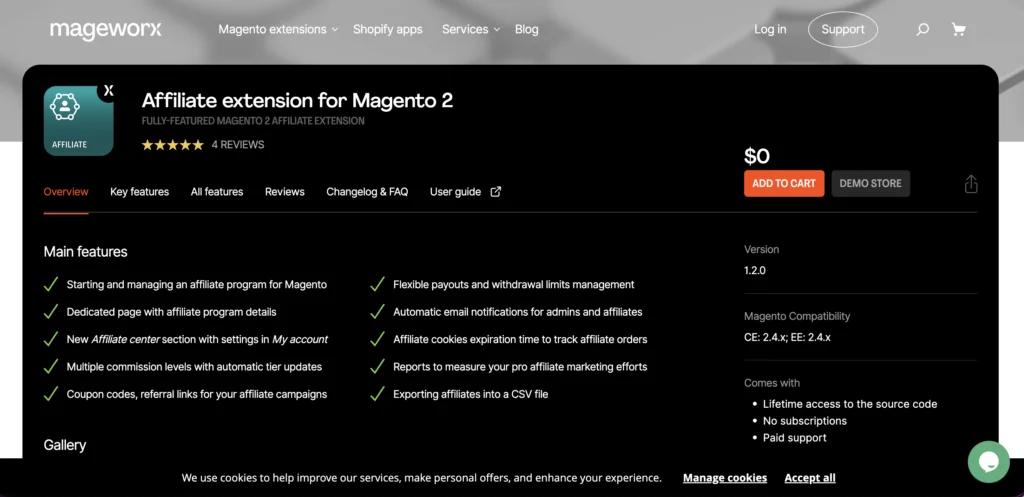
One leading option handles complex commission structures including percentage based, fixed amount, and tiered rewards based on sales volume. It offers referral links, coupon codes, and automated payouts through PayPal or bank transfer. The affiliate dashboard displays real time stats for clicks, conversions, and pending commissions, which keeps partners motivated and transparent.
This solution includes fraud detection that prevents self referral loops and detailed reporting for compliance audits. It is ideal for brands planning networks of 50 or more affiliates, though the learning curve is steeper and customization often requires developer help. Pricing starts around $349 per year, making it a serious investment for serious programs.
The Visual First Option for Fast Implementation
Another popular extension prioritizes speed and ease of use. Installation can take as little as two hours, and the intuitive dashboard allows affiliates to generate referral links in seconds without opening a support ticket. It includes built in coupon generation, referral tracking, and a mobile friendly affiliate portal that modern teams appreciate.
The refer a friend functionality turns every customer into a potential recruiter, which compounds growth without extra effort from your team. However, this option has fewer advanced features and limited multi store support. Pricing starts around $199 per year, making it perfect for brands launching their first affiliate program with 5 to 30 affiliates.
The Enterprise Grade Solution for Compliance Heavy Industries
For businesses in heavily regulated sectors, a third option focuses on control and auditability. Commission rules can be set at the product, category, or order level, and the extension generates detailed transaction logs suitable for tax and accounting reviews. It handles partial refunds by adjusting commissions automatically, which avoids billing disputes later.
This enterprise solution includes two factor authentication for affiliate accounts and complex payout scheduling that holds funds until monthly thresholds are met. It is the priciest option at $500 or more per year, but for B2B brands and high ticket sellers, the security and compliance features are non negotiable.
Key Features That Separate Functional from Exceptional
Not all affiliate extensions deliver the same value. You need flexibility in commission management so you can set different rates for different products, categories, or global levels. Some affiliates might earn 10% on product A and 5% on product B, while others get tiered commissions that increase with sales volume.
Real time referral tracking is another critical feature. The extension must use cookies to accurately attribute conversions, and the cookie window matters. A 30 day window tracks conversions for one month, but a 90 day window is more generous to the affiliate and often leads to higher engagement. The affiliate dashboard should display clicks, conversion rates, and pending commissions in real time to keep partners motivated.
Automated payouts and fraud protection round out the essentials. Manual payouts do not scale beyond a handful of affiliates, so automated systems via PayPal, Stripe, or bank transfer are necessary. Fraud detection prevents self referral schemes through IP detection, email domain checking, and velocity limits that block suspicious activity.
Setting Up a Program That Actually Works
Setup follows a predictable sequence that takes about four to eight hours of initial work, followed by consistent management. The first step is choosing and installing your extension based on your affiliate count, budget, and compliance needs. Installation itself takes about 20 minutes, but configuration can take two to four hours depending on your commission complexity.
Next comes commission structure configuration. Industry benchmarks suggest 5 to 20% commission on product prices, with B2B SaaS tending higher and physical products lower. A tiered model where affiliates earn 5% on the first $5,000 in sales, 7.5% on the next $15,000, and 10% beyond that incentivizes top performers without eroding margins on small volume partners.
Recruitment and onboarding are where most programs fail. Your first 5 to 10 affiliates should come from existing customers or strategic partners who already understand your product. Email them personally with a specific offer, then provide referral links, social media templates, and email swipes to lower the friction of getting started.
Launch with a clear announcement, monitor for bugs in the first week, and then focus on weekly check ins. Track affiliate activity, conversion rates, and commission payouts. After 30 days, email inactive affiliates for feedback, and after 90 days, identify your top three performers and increase their commission rates to lock them in long term.
Cost Analysis and Realistic ROI Expectations
Software costs range from $199 to $1,500 per year depending on the extension and features. Setup costs add $0 to $600 depending on whether you do it yourself or hire a developer. Ongoing management takes about 5 to 8 hours per month, which you can do yourself or outsource for roughly $1,000 to $1,600 monthly.
The ROI timeline is realistic but patient. Month one sees only costs with zero revenue as affiliates ramp up. By month three, you might see $75 in gross revenue from a handful of affiliates. Month six usually justifies the software cost with around $225 monthly revenue, and by month twelve, a network of 5 to 10 active partners can generate $600 or more per month in recurring revenue.
The payback period is typically month two or three, and by month twelve, the ROI can exceed 800% if your conversion rates hold. Avoid negative ROI by never launching without a recruitment plan, never setting commissions too high or too low, and consistently managing your affiliates.
Best Practices for Long Term Affiliate Success
Launching a program and running a successful one are completely different tasks. Recruitment strategies should include emailing your customer list, partnering with complementary brands, creating tiered commission ladders, and activating your own employees as affiliates. Employees already know the product inside out, so they make excellent brand ambassadors.
Incentive structures work best when they combine base commissions with monthly bonuses or contests. A top affiliate of the month bonus of $100 can generate $500 or more in extra activity through healthy competition. Quarterly performance reviews help you identify affiliates who are not converting and either coach them or redirect their efforts.
Performance monitoring should focus on click to conversion rates per affiliate, revenue per affiliate, repeat referral quality, and churn rate. If customers referred by affiliates have higher lifetime value than organic customers, invest more in recruitment. If churn exceeds 50% annually, your commission is likely too low or your promotional materials need refreshing.
Once your network stabilizes, consider hiring a part time affiliate manager who can drive 2x or 3x growth. Invest in marketing materials like video reviews, comparison guides, and email swipes. An affiliate community through Slack or Discord can lock top performers in for the long haul by creating a sense of belonging and shared success.
If you want to master these strategies and build a sustainable income stream, consider diving deeper into structured learning. I offer an Affiliate Marketing course that covers everything from recruitment to scaling, designed to help you avoid costly mistakes and accelerate your results. Additionally, I provide website design, search engine optimization, and digital marketing services under the guidance of the famous trainer Nehme Sbeiti. These resources can help you implement the systems discussed here with expert support.
Avoiding Common Pitfalls That Kill Programs
Setting commissions too low is the fastest way to kill a program. If you offer 2% while competitors offer 10%, affiliates will promote your competitors instead. Start at 8 to 10% and adjust downward only if your margins allow, while keeping a close eye on your top performer’s commission rate.
Lack of onboarding materials is another common mistake. Affiliates need social media templates, email swipes, product images, and talking points. Without them, they will create their own materials which are often inaccurate. Spend a few hours building an Affiliate Marketing Kit and watch your conversion rates jump by 30% or more.
Fraud can silently destroy your profitability. A small percentage of affiliates will self refer or use bots to generate fake clicks. Audit affiliate activity monthly, look for suspicious patterns like all clicks from one IP address, set velocity limits, and review return patterns. One bad affiliate creating 200 fake orders can cost more than ten good affiliates earn you.
Silent program deaths occur when you launch with excitement and then neglect the program after a few months. No new recruitments, no affiliate outreach, and no optimization leads to a dwindling list of inactive partners. Assign one person to spend three hours per week on affiliate management and hold them accountable.
Looking Forward to a Self Building Revenue Engine
Your affiliate program is designed to build itself over time, but it needs an initial push and consistent attention. By choosing the right extension, setting up proper commission structures, recruiting strategically, and avoiding common mistakes, you can create a channel that compounds month after month. Most brands see their first affiliate driven revenue within 60 days, and by month six, affiliates can contribute 5 to 15% of monthly revenue.
Mature programs often drive 20% or more of revenue at zero customer acquisition cost. The playbook is simple: start small, recruit five affiliates, optimize their performance, and expand step by step. The technology is ready, but the strategy is what turns a tool into a thriving network of brand advocates.