Imagine you are launching an Affiliate initiative tomorrow. You have the product, the commission structure, and the enthusiasm. But there is one glaring problem: you need names. You need twenty partners who will actually promote your brand, and you need them fast. Where do you even start?
This scenario is the ultimate litmus test for choosing the right operational model. If your immediate instinct is to browse established marketplaces for coupon sites, cashback platforms, and content creators, you are likely looking at a network solution. However, if your mind goes to the consultants you already know, the customers who rave about you, or the agencies you have worked with for years, you might be better served by building your own program with dedicated software.
This decision goes far beyond just finding names. It dictates how you manage relationships, how you handle tracking, what your cost structure looks like as you scale, and ultimately, who takes responsibility for the program’s daily operations. Let’s dissect the differences between the network model and the standalone software model to see which aligns with your business reality.
The Core Difference: Sourcing Partners vs. Building Infrastructure
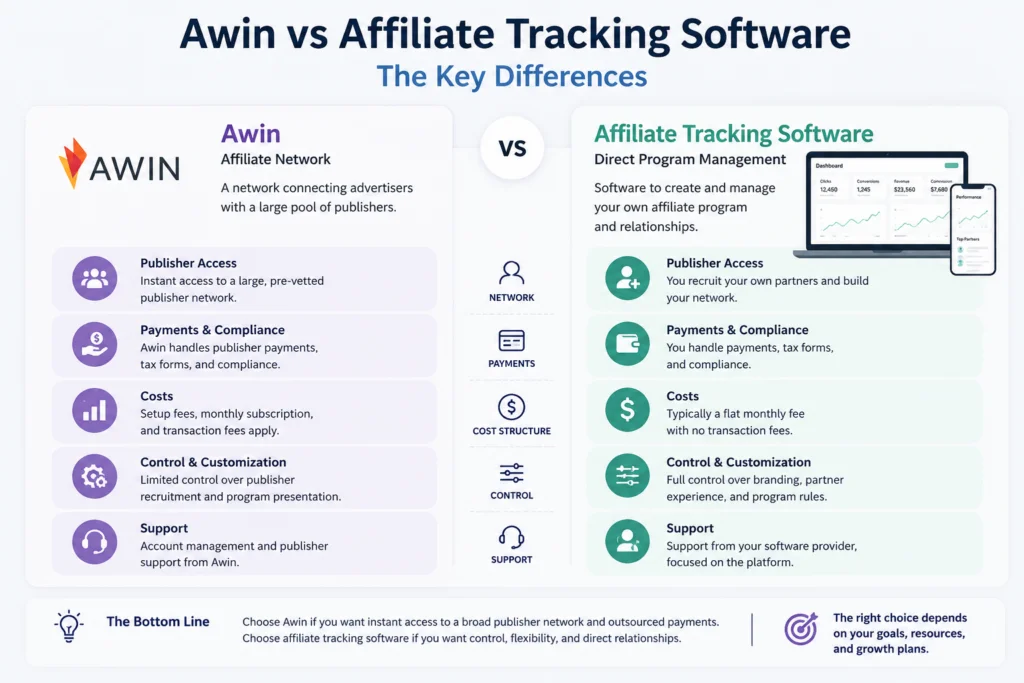
The primary distinction lies in what you are actually paying for. A network like Awin offers a dual value proposition. On one hand, it provides a massive marketplace where advertisers and publishers can find each other. According to their materials, this includes access to over a million global partners ranging from influencers to technology firms. On the other hand, it offers the tracking and payment infrastructure necessary to manage those relationships once they are established.
Standalone affiliate tracking software takes a different approach. It assumes you have the ability, or the existing relationships, to find your own partners. These platforms, such as Tapfiliate, focus exclusively on providing the tools to run the program: link generation, commission tracking, payout management, and reporting. You bring the partners to the table; the software handles the operational heavy lifting.
To visualize this, consider a retail brand entering a new geographic market. They have no local contacts. In this case, the network’s directory is invaluable. The team can search for local voucher sites and shopping content publishers immediately. Conversely, think of a B2B software company whose founders are well-known in their industry. They can simply email their network of consultants and offer a referral deal. For them, paying a network fee to find partners they already know would be a waste of budget.
The Network Advantage: Reach and Validation
When you join a large network, you are buying access. The value proposition is simple: you gain visibility to publishers who are already active and looking for programs to promote. This is particularly useful for breaking into new niches or scaling quickly. The network also handles the administrative burden of validating transactions and paying affiliates, which can be a relief for teams without dedicated finance support.
However, access does not guarantee activation. Having a million partners in a database means nothing if none of them are relevant to your specific audience. You still need to pitch your offer, provide creative assets, and convince these publishers that your product is worth their time. The network opens the door, but you still have to walk through it and make the relationship work.
The Software Advantage: Control and Brand Experience
With tracking software, you are the architect of your own program. This model is ideal for businesses that have a “partner pipeline” already in place. Perhaps you have customers who consistently refer business, or integration partners who recommend your service during implementations. Here, the software acts as the engine room, allowing you to set specific commission rules, create branded dashboards, and communicate directly with your partners.
This approach offers greater control over the user experience. You can customize onboarding flows and commission structures to suit different partner groups. For instance, a subscription company might set up recurring commissions for a consultant who refers a long-term client, while offering a flat rate for a one-time sale. This flexibility is often harder to achieve within the rigid structure of a large network environment.
Operational Differences: Tracking, Validation, and Payouts
The way you validate sales and issue payments differs significantly between the two models. In a network, the platform often takes on the responsibility of paying publishers. They aggregate all the sales from various advertisers and issue one payment to the publisher. This is convenient for the affiliates, as they receive “network currency” that is pooled together. For the advertiser, it means less administrative hassle in terms of individual payments, but you are paying a transaction fee for this service, which is often a percentage of the sale value.
With standalone software, the business typically remains responsible for the payout workflow. The software calculates the commissions, but the actual transfer of funds is usually handled by the company. While this adds administrative work, it also keeps the relationship with the affiliate more direct. You control when commissions are approved, and you can handle refunds or chargebacks according to your specific policy. This is crucial for businesses with long sales cycles or high return rates.
Consider the tracking mechanics as well. A network uses its own cookies and tracking parameters. If you use a network, you are reliant on their technology to attribute the sale. Standalone platforms often offer more versatile tracking options, including server-to-server postbacks and API integrations. This is essential for companies with complex customer journeys, such as those involving free trials that convert to paid subscriptions months later.
Cost Structures and Total Investment
Pricing models are a major differentiator. Networks like Awin often combine a monthly subscription fee with a tracking fee based on the value of each transaction. While the entry-level fees might look low, these transaction fees can escalate quickly as your sales volume grows. You are paying a toll on every single sale attributed through the network.
Affiliate tracking software usually operates on a flat subscription model, with tiered plans based on usage limits like the number of clicks or conversions. This predictable pricing model is often easier for finance teams to forecast. However, you need to account for the internal time required to manage the affiliate relationships, answer questions, and process payouts manually if you do not utilize an integrated payment provider.
To truly compare costs, you must model both scenarios. Take your projected average order value, your commission rate, the platform fees, and the associated transaction costs. Then, add the value of your time. The cheaper subscription fee might be negated by the hours you spend managing partners that a network could have helped you activate faster.
Finding Your Fit: A Framework for Decision Making
The decision ultimately boils down to your starting point and your strategic goals. If you are looking at the “first twenty partners” test, your answer reveals a lot. If you cannot name twenty people or companies who would promote you without a network introduction, then the network model is likely the necessary catalyst to get you off the ground.
However, if you are sitting on a goldmine of existing advocates, you should leverage that. Running a program where you control the rules, the branding, and the partner experience is incredibly powerful. It allows you to build a community around your brand rather than just renting space in a directory.
Practical Considerations Before You Commit
Before signing any contract, walk through the entire customer journey with the provider. Map out what happens from the click to the payout. Ask specific questions: How is the affiliate identifier stored? What happens if the customer uses a coupon code? How are refunds handled retroactively? These technical details will determine whether the platform can actually support your business model.
Let’s take an example of a course creator selling a high-ticket digital product. They might want to offer affiliates a 30% recurring commission. They need a platform that can track a sale, and then continue to attribute commissions on subsequent upsells without requiring the customer to use a new link each time. This level of technical nuance is where the “feature list” either delivers or falls short.
Furthermore, do not underestimate the importance of de-duplication. If you decide to run both a network and your own software, you need clear rules for what happens when a customer clicks a link from a network publisher but later converts through a direct referral link on your software. Both systems might claim the sale. Without a clear protocol for attribution priority, you will end up paying double commissions or damaging partner trust.
When Two Systems Make Sense
Running a hybrid approach is not only possible but often necessary for scale. A large ecommerce operation might use a network to reach voucher sites and large cashback portals that are critical for volume. Simultaneously, they might use a software platform to manage a loyalty program for their existing customers who refer friends in exchange for store credit.
The key is to treat them as distinct channels. You must decide which partners belong in which system and ensure they do not overlap. If you have a trusted advisor who creates content, they might be better in your direct program where you can offer them a better commission rate than what the network dictates. By separating the channels, you can optimize the economics of each.
Your Strategic Takeaway
Choosing between a network and a software solution is not a matter of which is “better,” but rather which aligns with your current business maturity and partner acquisition strategy. The network is a discovery engine; the software is an operational toolkit. You must determine if your primary need is reaching new audiences or managing existing relationships more efficiently.
As you build your strategy, remember that the affiliate landscape is evolving. The best programs are those that treat partners as genuine extensions of the marketing team. If you find yourself struggling to structure this program or if you need a comprehensive digital strategy to support your launch, consider investing in professional training that covers the nuances of digital marketing and monetization. Experts like Nehme Sbeiti offer insights into converting traffic into sustainable revenue, ensuring your efforts yield the best possible return on investment.
Ultimately, the future of your program lies not in the platform you choose, but in the strength of the relationships you nurture. Pick the tool that gives you the most leverage to build those relationships, whether through broad discovery or deep integration, and commit to the long game. The infrastructure is important, but the connections are what truly drive revenue.
Start small, test rigorously, and scale what works. The platform is simply the vehicle; you are the driver.