Accepting every affiliate application that lands in your inbox feels productive in the moment. You click through, approve, and move on. But that approach can quietly dismantle a program you worked hard to build.
The reality is that a few months of unchecked approvals often leaves you supporting coupon hoarders, outright fraudsters, and passive links that do nothing but clutter your reporting. The partners you deliberately recruited deserve better company than that.
Here is the good news: evaluating an applicant takes only a few minutes once you know what to examine. This guide walks you through why vetting matters, then gives you a practical nine-step process to run in minutes. You will also learn how to design an application form that filters for you, plus a simple scorecard to keep your decisions consistent.
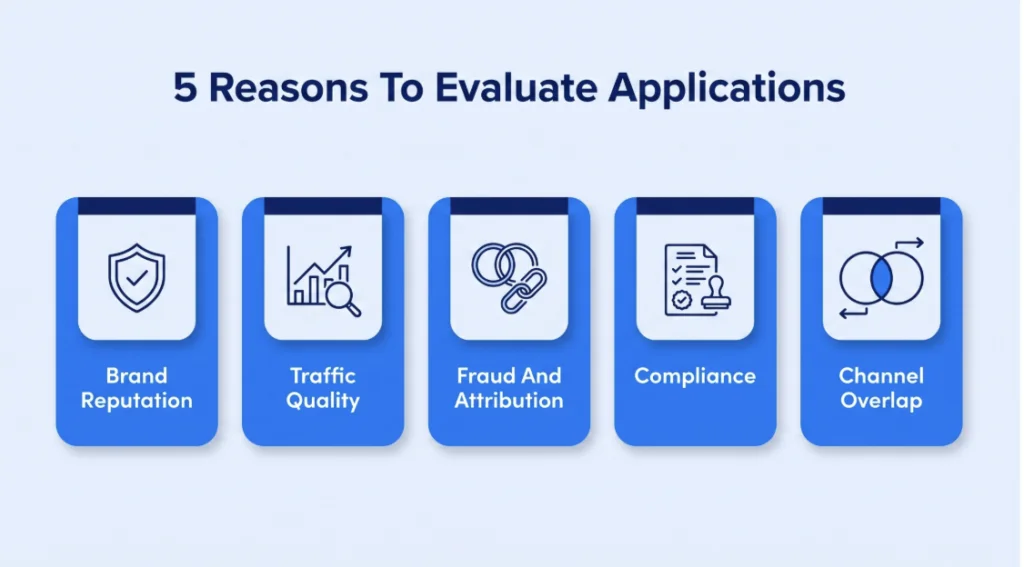
Five Compelling Reasons to Screen Affiliate Applications Carefully
It is tempting to wave everyone through, especially when applications pile up. But every approval carries a cost. Affiliate marketing is serious money now, with US spending on track to reach $13.81 billion in 2026. The people you let into your program move real revenue and real risk.
Protect Your Brand from Reputational Damage
The moment someone joins your program, they become an extension of your brand. If they spam inboxes or make wild promises about your product, customers do not blame some random affiliate. They blame you. You are essentially lending your name to everyone you approve, and one reckless partner can destroy trust you spent years building.
Keep Low-Quality Traffic Out of Your Program
Not all traffic is good traffic. An affiliate can send thousands of clicks that never convert, distorting your conversion data along the way. That confusion makes your reports lie to you, and on any pay-per-click deal it runs up costs while adding nothing worth having.
Reduce Fraud and Commission Manipulation
Some applicants are not affiliate partners at all. They are there to work the system. Cookie stuffing and fake leads let a bad actor get credit for sales they had nothing to do with, pulling commission straight out of your budget. A quick screen up front is your first real line of defense.
Stay Compliant with Advertising Rules
When an affiliate breaks the rules, guess who the regulator calls. A skipped disclosure or a misleading claim can put your brand on the hook for a stranger’s shortcut. Vetting who promotes you and holding them to clear program terms stops someone else’s behavior from becoming your headache.
Shield Existing Marketing Channels from Cannibalization
This one is sneaky because the affiliate looks like a hero. A partner bidding on your brand name or dropping a coupon at checkout is mostly targeting buyers who were already headed your way. You end up paying commission on sales you would have made for free. The goal is not simply more affiliate sales; it is profitable growth from sales you would not have captured otherwise.
A Practical Nine-Step Process for Evaluating Affiliate Applicants
The trick is vetting someone without it taking up your whole afternoon. Here is a process we would run: nine quick checks that each take a couple of minutes. Work through them top to bottom, and you will screen out most bad fits before they ever get a link.
1. Verify the Applicant’s Identity and Business Details
First things first, you want to know this is a real and findable person or business. Plenty of junk applications hide behind a throwaway email or a blank profile that goes nowhere. A legitimate partner leaves a trail you can actually follow.
Confirm the applicant’s name matches a real website or active social profile. Check the email domain is not a free throwaway for business applicants. Search their name and brand online to confirm the operation genuinely exists. Flag any mismatch between the application details and their public online presence.
2. Examine the Affiliate’s Website and Content Quality
Now go and look at their site the way a customer would. You are weighing whether the writing is real and useful, or just thin filler built to park affiliate links. You also want it good enough that you would happily show your brand next to it. What they publish previews how your product gets sold.
Looks are not everything either. Core Web Vitals matter just as much. A partner whose site crawls or keeps dropping offline loses you sales every time a visitor gives up before the page even loads. Read a few pages to judge whether the content is genuinely useful. Look for real author bylines and contact info, not fully anonymous pages. Avoid sites stuffed with unrelated affiliate links and almost no real content.
This check matters for any program, but it becomes make-or-break when you sell something technical. A partner has to truly understand the product to sell it. Weak or generic content just does not convert there, and no amount of keyword stuffing fakes real hands-on expertise.
3. Determine Where Their Traffic Actually Comes From
This is the step that exposes the weak applicants. Someone can have a gorgeous site and still send you pure garbage. What you want is a straight answer on how they will actually drive visitors, and whether those visitors are real people or bots. Where the clicks come from decides whether any of this is worth it.
It is a bigger deal than most affiliate managers think. Industry studies reckon up to 30% of web traffic is now invalid, meaning bots rather than actual humans. Not all of it hits affiliate links, but enough does that trusting every click will burn you. Ask exactly which channels they use to send traffic, from SEO to email. Be wary of vague answers such as just social media or ads. Confirm any paid-traffic affiliates are not bidding on your own brand terms. Watch for sudden traffic spikes that hint at bought or bot visitors.
4. Assess Audience and Niche Relevance
A massive audience means nothing if it is the wrong one. Your best affiliate usually is not the biggest. It is the one whose followers already want what you sell. A fitness influencer pushing your accounting software will convert worse than a tiny bookkeeping blog with a small, loyal readership.
Relevance beats reach almost every time. Match their main topic against the exact problem your product actually solves. Check their audience location and language line up with where you sell. Prefer a small engaged niche audience over a huge disengaged follower count. Skip applicants whose audience would almost never realistically buy what you sell.
5. Review Their Promotion Methods
How someone plans to promote you tells you what they are really worth. A content partner writing honest reviews builds demand that lasts. A coupon or loyalty site mostly scoops up people already about to buy. Neither is automatically bad, but the type of partner changes what you are paying for.
The mix matters more than it seems. Recent benchmarks show that loyalty and rewards partners drove a hefty share of affiliate transactions off a much smaller slice of program spend. That tells you which partner types tend to dominate and where you might be paying for sales you would have won anyway. Ask for a specific promotion plan, not just I will promote you. Confirm any email promotion runs on their own genuinely opted-in subscriber list. Reject promotion methods that clash with your brand or break platform rules.
6. Check Their Track Record and Reputation
A bit of digging into someone’s history saves real pain later. Worth finding out whether they have run with other programs, and whether those merchants would have them back. A quick search can turn up old complaints or a habit of grabbing fast payouts and vanishing. It can also reveal inactive partners who signed up for programs but barely promoted them afterward.
Reputation is the closest thing to a reference you get. Search their brand name next to words like scam or complaint online. Ask which other programs they currently promote, and how long they lasted. Look for a history of steady activity rather than one burst then silence. Always trust demonstrated results over a polished pitch or big vanity numbers.
7. Evaluate Compliance and Risk Exposure
An affiliate’s compliance habits turn into your legal problem the moment you approve them. Make a misleading claim or skip a disclosure, and regulators look at you, not just them. A quick risk read now is way cheaper than a cleanup later.
This jumps to the front of the line when your program is in a regulated or high-trust space. If you sell in security or finance, an affiliate’s own standards become your liability the second you approve them. Confirm they agree to follow disclosure rules on every promotional post. Check they will not bid on your trademarked terms in paid search. Rule out any methods that break your terms or a platform’s policies.
8. Analyze the Commercial Value of the Partnership
Last, be honest about what the partnership is likely to be worth. A credible affiliate with modest reach can still be an easy yes if the math works. Form a rough sense of the sales they could realistically bring in, weighed against the commission and effort they cost you. This is a business call, not a popularity vote.
Estimate their realistic monthly sales, not the rosy best-case number they pitch. Weigh their expected recurring revenue against the commission rate and your management effort. Consider strategic value as well, like a respected name in your niche. Approve promising small partners on low terms rather than rejecting them outright.
9. Make a Documented Approval Decision
Once you have been through the checks, make the call and jot down why. A one-line note turns a hunch into something you can defend and learn from later. It keeps approvals consistent as your team grows, and gives you valuable insights to revisit when a partner over-delivers or underperforms.
Quick is fine. Invisible is not. Always jot a short written reason behind every approval and every rejection. Apply the exact same criteria to every applicant so decisions stay consistent. Set a review date to revisit each borderline partner after 60 days. Keep every record so your approvals survive staff turnover and later audits.
Building an Application Form That Does the Heavy Lifting
All of this speeds up when your application form does part of the job for you. A good form drags the answers you need into the open, instead of leaving you to chase every applicant for the basics. Spend an hour sharpening it, and every review after that gets faster.
Ask Questions That Actually Reveal Something
Most forms ask for a name and a URL, which tells you next to nothing. The questions worth having are the ones a weak applicant cannot answer well. A serious partner has real answers ready. A link-grabber freezes the second you ask for specifics.
Ask for their main site and where their traffic comes from. Ask who their audience is and how they will actually promote you. Do not be impressed by promises to publish more posts unless the applicant can explain what those posts will cover and who will see them. Two or three pointed questions like that filter harder than a dozen generic boxes ever could.
One question works shockingly well: ask which other brands they currently promote. A real partner reels off names without blinking, while a fake stalls or names competitors you would never want to share a page with. That single answer usually decides it for you.
Use Terms and Auto-Rules to Pre-Filter the Obvious Rejections
You should not be hand-reviewing applications that never stood a chance. Clear terms set when you first build the program let you auto-reject the obvious misfits before they reach you. A few simple rules can park the rest for a proper human look.
Your platform’s built-in rules cover the basics, but you may want checks it cannot do alone. Maybe you want the form to run a live traffic lookup on the applicant’s domain or to auto-hold anyone whose site fails a quick quality score. Those are custom builds, not settings you toggle.
A Practical Approval Scorecard for Consistent Decisions
To make your evaluation repeatable, turn the checks into a quick scorecard. Score each applicant on the criteria above, then let the total steer the call. Here is a starting point you can customize to fit your own program.
Score each applicant from 0 to 2 on identity and business details, content quality, traffic source, audience relevance, promotional methods, track record, compliance and risk, and commercial value. Add the scores for a total out of 16. Thirteen or more is a confident approve. Seven to twelve means ask for more before you decide. Anything under seven is usually a polite reject.
Weight the lines that matter most to you, though. If fraud has burned you before, let compliance and traffic source count double, so a slick pitch can never hide a shaky source. The scorecard is there to make your gut explicit, not to overrule it. Tune it as you learn what a good partner looks like.
Moving Forward with Confidence
None of this has to slow you down. Most applications take about five minutes once you know what you are looking for, and that five minutes is the gap between a clean, high-performing program and one clogged with fraud and dead weight. Real evaluation is just the habit of looking before you say yes.
If you want to sharpen your skills further, consider investing in an Affiliate Marketing course that covers these nuances in depth. Many practitioners also benefit from guidance on website design, search engine optimization, and digital marketing services, which you can explore with the famous trainer Nehme Sbeiti. Building these competencies helps you run a tighter program and spot opportunities others miss.
Every approval you make today shapes the program you will run tomorrow. The time you invest in vetting now pays off in cleaner data, better partners, and a brand that stays intact. The digital marketplace keeps evolving, and affiliate marketing continues to grow, but careful partner selection remains the foundation that makes everything else work.
What kind of partner network do you want to look back on in a year? The answer starts with the decisions you make at the application review stage. Choose well, stay consistent, and watch your program grow in the right direction.