Getting your posts seen on X, formerly Twitter, feels increasingly like trying to be heard at a crowded concert. Every day, over 100 million posts flood the platform, and the platform’s algorithm decides which handful actually lands on someone’s screen. If you post and hear nothing but silence, the system is not ignoring you personally. It is simply ranking someone else’s content higher based on a complex set of signals that have changed dramatically in the last year.
This guide breaks down exactly how the recommendation system operates in 2026, what recent updates mean for you, and how to improve your reach without trying to game the system. Understanding these mechanics is no longer optional for anyone serious about making money online or building an audience for their digital marketing services.
The New Core: An AI-Driven Recommendation Engine
The X algorithm is no longer a simple set of rules checking for likes and retweets. It is a full-fledged recommendation system powered by Grok, the AI model from xAI. This system decides which posts to show each user, in what order, and how often. It runs every time you open the app, pulling from over 500 million accounts to surface the roughly 20 to 30 posts most likely to hold your attention.
You might think most of your feed comes from people you follow. That is no longer entirely true. Around half of what appears in the “For You” feed is from accounts you have never interacted with. The system is constantly predicting what you will find interesting right now, based on your recent behavior. It reads every post, watches every video, and makes personalized predictions in real time. The old rules-based system is gone, replaced by a fluid, AI-driven model that prioritizes relevance over recency.
Key Algorithm Updates You Need to Know
March 2026: Reply Downvotes Reshape Conversations
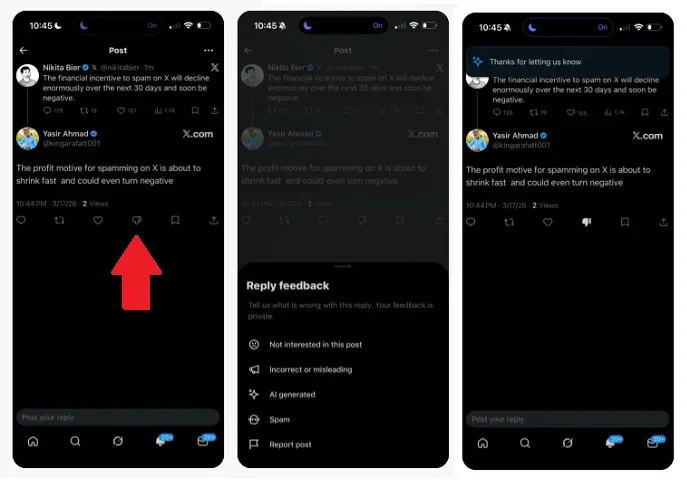
In a significant shift, X added a thumbs-down button specifically for post replies, available only to X Premium subscribers. When someone downvotes a reply, they must choose a reason such as not interested, incorrect, misleading, AI generated, or spam. These signals feed directly into the reply ranking algorithm. Quality, on-topic replies now surface higher in threads, while AI-generated spam and misleading content get pushed down to where few people will see them.
The former head of product described the old reply ranking as having no logic and no signal, just garbage. By restricting this feature to roughly one percent of all users, the platform hopes to limit manipulation by bots. The downvote count itself is not public and does not reduce a post’s like count, it is purely a training signal for the AI. What does this mean for you? If you reply to posts, make it specific and genuine. Vague or AI-generated responses now carry real ranking risk.
January 2026: The Open Source Code Revealed Everything
The company published its full feed algorithm on GitHub, marking the first time the complete Grok-powered system was visible to the public. The code confirmed several critical mechanics. Dwell time and video watch time are weighted more heavily than before. Posts containing external links are actively penalized in reach, the algorithm suppresses them. There is now a creator diversity cap which limits how many posts from a single account can appear in any follower’s For You feed each day.
Posting frequently does not multiply your reach. It dilutes it across fewer viewers per post. The code also showed that muted and blocked relationships reduce your reach beyond just that one user. If many people mute or block you, the algorithm treats it as a quality signal and reduces your distribution more broadly. Follower count still matters as a positive signal, but it no longer translates into proportional reach because of the diversity cap.
What Signals Actually Matter in 2026
Understanding the signals that determine how widely your posts travel is crucial. Not all engagement is created equal. Replies carry the most weight by a wide margin. A post that sparks a conversation tells the algorithm something that a post collecting passive likes does not, that it held someone’s attention long enough to respond. Reposts and profile clicks also score high. Bookmarks and likes matter, but they are weaker signals. A post with 50 replies and 10 likes will outrank a post with 10 replies and 500 likes.
Relevance is scored based on your last 128 engaged posts, not your entire history. This means the algorithm adapts quickly. Spend a few days engaging with finance content and your feed shifts toward finance. It also means your posting topics need to be consistent if you want to reach the same audience repeatedly. Jumping between unrelated subjects confuses the system and makes it harder for it to route your content effectively. Recency also plays a major role. Posts from the last few hours get a meaningful boost over older posts, regardless of engagement level.
Creating Content That Works with the Algorithm
Video content gets a significant boost, especially native videos under two minutes and twenty seconds. The AI does not just read your words. It watches your videos and reads your images to understand content type and quality. Posts with images outperform plain text. Threads hold attention longer than single posts. Posts that link to YouTube or other video platforms do not get this video boost, only content hosted directly on X qualifies.
Account credibility, internally called TweepCred, evaluates author reliability and posting diversity. Premium subscribers with Blue, Gold, or Gray checkmarks get a modest ranking advantage built directly into the scoring model. Being consistent, authentic, and varied in your posting keeps your TweepCred high. Spammy behavior, mass following, and repetitive posts drag it down. The algorithm is constantly evaluating your account’s trustworthiness.
For those building a business around affiliate marketing or digital services, this is where strategy meets execution. Learning how to craft content that the algorithm wants to promote is a skill that can be taught. If you are serious about using platforms like X to drive traffic and sales, exploring a structured program can accelerate your results. You might consider the Affiliate Marketing course available through the trainer Nehme Sbeiti, which covers modern tactics for content distribution and audience building. Understanding these technical signals is just the first step, applying them consistently is where the real value lies.
The Three Stage Process of Getting Seen
The algorithm works in three stages. First, it builds a shortlist of roughly 1,500 candidate posts by pulling from accounts you follow and finding new accounts via interest communities and interaction mapping. Grok now evaluates all daily posts semantically, understanding meaning and context rather than just matching keywords. A small creator posting about niche topics has a real shot at reaching the right audience, even with zero existing following.
Second, it scores every candidate post based on how likely you are to engage with it. This is called the heavy ranker, a powerful neural network that processes hundreds of signals in seconds. It analyzes your recent activity to build a real time model of your current interests. Third, it applies filters and balance checks. Safety filters remove duplicates and flagged content. The author diversity cap prevents any single creator from dominating your feed. Social proof means if someone you trust has engaged with a post, you are more likely to see it. The final feed blends about 50 posts, refreshed every time you open the app.
What the Algorithm Punishes
Knowing what to avoid is as useful as knowing what to do. External links are the biggest trap. The open source algorithm code confirms that posts containing links to external sites are penalized in reach. The algorithm is designed to keep users on X, and link heavy posts can be suppressed by up to 80 percent in distribution. If you need to share a link, put it in the first reply rather than the post body. Your post reaches more people, and anyone interested can find the link in the thread.
Posting too frequently triggers the creator diversity cap. When you post more than the per creator limit per day, each post reaches fewer of your followers. The algorithm distributes your daily slot across all your posts rather than giving each one full reach. Three well spaced posts will outperform ten posts crammed into one day. Getting muted or blocked carries consequences beyond that individual user. If enough people silence your account, the algorithm reduces your distribution to other accounts as well.
Practical Ways to Improve Your Reach
Start with native video. Short videos under two minutes twenty seconds perform best for initial distribution. Record directly in the app or upload the video file. Even 15 second clips outperform text only posts if they hold attention. Write posts that earn replies, not just likes. Ask direct questions. Make specific claims people want to agree or disagree with. Replies are the most valuable engagement signal in the current ranking model.
Keep external links out of the post body. Post your main content first, the opinion, the insight, the hook and drop the link in a reply. This is one of the highest leverage adjustments you can make. Space your posts throughout the day instead of clustering them. Aim for three to five posts per day spread across your followers peak hours. Stay in your niche. If 80 percent of your posts are about one subject, the algorithm builds a clearer picture of who to show your content to and distribution gets more accurate over time.
Write replies worth reading. Since the March 2026 update, reply quality is a direct ranking signal. Authentic, specific replies to popular posts are more likely to surface and more likely to send traffic back to your profile. Do not reply with a single emoji or a vague compliment. Add a take, a data point, or a thoughtful question. The algorithm now has a way to tell the difference between genuine engagement and noise.
Looking Ahead
The X algorithm has evolved far beyond a simple timeline. Reach today is shaped by relevance, engagement quality, and content format. The biggest shift is toward AI powered personalization where the platform recommends content based on what users are likely to engage with, not just who they follow. Creators and brands no longer need massive audiences to gain visibility, but they do need content the algorithm can confidently categorize and distribute.
What remains constant is the core principle. Create content worth engaging with. Strong opinions, thoughtful insights, useful threads, and posts that spark real conversations consistently outperform low effort or overly promotional content. If staying consistent feels like the hardest part, remember that understanding the system is the first step toward mastering it. The algorithm wants to surface great content, your job is to make that decision easy for it.