You have posted this week. Perhaps you have posted every week this month. Your Reels are online, your Stories are running, and the content calendar is technically active. Yet the trial sign up rate has not moved. When a gym owner asks what social media is doing for their membership numbers, the honest answer is harder to give than it should be.
This version of the problem rarely gets addressed in marketing guides. It is the challenge of consistent posting with no clear line back to new members. Whether you own the gym or manage social media for gym owners, you know this frustration well.
Chris Cooper of Two-Brain Business, who has worked with thousands of gym owners globally, puts it plainly: “Likes do not pay the rent for a gym.”
The problem is not content quality. Gyms post better content today than at any point in social media history. The problem is structural. Each platform has a specific job in the membership funnel, and most gym social media strategies treat every platform as a broadcast channel rather than a conversion system. If you are serious about turning followers into paying members, consider diving into an Affiliate Marketing course that teaches conversion focused content strategies for service based businesses. Many of the same principles of audience building and trust apply directly to the fitness industry.
This guide builds the platform by platform playbook that closes that gap. Every section answers the same four questions: what to post, how often, what call to action to use, and what metric tells you it is working.
Why Your Gym’s Social Media Is Not Bringing in New Members
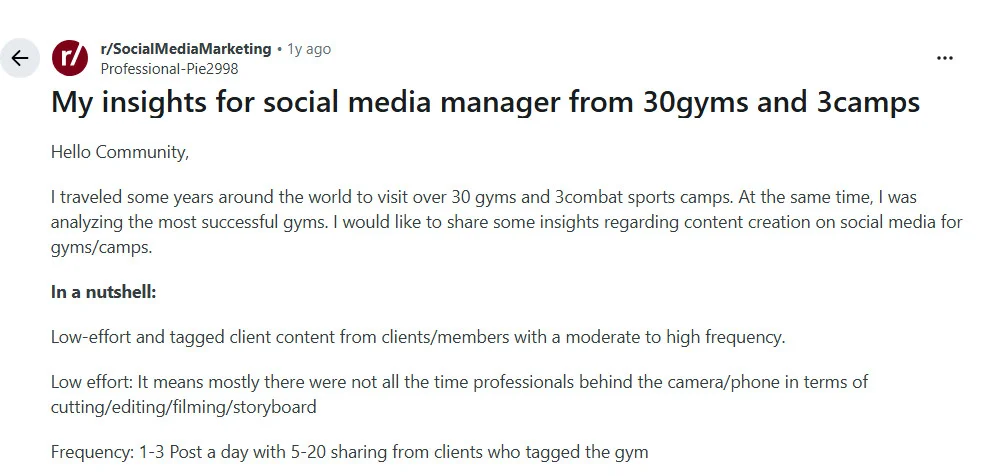
The pattern is consistent across gym accounts of every size. An SMM who analyzed data from 30 gym accounts documented it directly in a thread on Reddit: high engagement, near zero membership attribution, month after month, with no structural explanation the clients could identify.
Two failure modes drive almost every case. The first is posting for members instead of prospects. Most gym content speaks to people who are already in the building. Member shoutouts, inside challenge updates, and “great class this morning” posts generate warm responses from the existing community but do nothing for the person scrolling who has never been to your gym. If your content only makes sense to people who already know your gym, it is not acquiring anyone new.
The second failure is having no conversion mechanism anywhere in the content. A post without a booking link, a DM prompt, or a trial offer has no path to membership. Engagement stays as engagement. Two-Brain Business states this plainly: “Posting value content without a weekly conversion post is brand awareness, not lead generation, and brand awareness alone does not fill classes.”
The fix requires two structural changes. Every piece of content should pass a single test: would a non member watching this have a reason to act? At least one post per week should ask explicitly for the business. That could be a free trial offer, a DM prompt, or a link to book a first class.
Choosing the Right Social Media Platforms for Your Gym
The most common mistake gym owners and their agencies make is trying to maintain a presence on every platform simultaneously. Content burnout follows quickly. A social media manager posted about this on Reddit nearly a decade ago, running out of content ideas in the first week before any real strategy was in place. The platform has changed, but the problem has not.
Start with two platforms. Build a working system. Add a third when the first two run without effort. Each platform has a primary job in the gym membership funnel. Instagram handles discovery and social proof for all gym types. Facebook manages community retention and local ads, especially for the 35 plus membership demographic. TikTok offers organic reach to non followers for an under 35 audience. YouTube builds authority and long form trust for established gyms with content bandwidth. Google Business Profile handles local search visibility and reviews for all gym types. Follow a step by step guide to set up a Google Business page and optimize it for local discovery. A complete and regularly updated GBP profile drives Google Maps placement and generates review based trust before a prospect ever visits your social profiles. Most gym owners set it up once and never touch it again.
For agencies managing multiple fitness studio accounts, gym type determines platform priority. A boutique HIIT studio targeting 26 year olds needs a completely different platform stack than a senior wellness center.
Set Up Your Profiles Before You Start Posting
Platform selection is only the first step. Before any post goes live, each profile needs to function as a conversion mechanism, not just a feed. Your bio is a sales page compressed into three lines. State what your gym does, who it is for, and what someone should do next. Use one link in bio pointed at one offer. A single landing page with a trial offer or a direct booking link performs well in every documented case.
Keep profile details consistent across platforms. Use the same profile photo, the same gym name spelled identically, and a bio that communicates the same core offer. Collecting more Google Business Reviews and tying your GBP into your social media cadence is one of the highest ROI steps a local gym can take before spending a dollar on paid ads.
How To Use Social Media for Gym, Platform Specific Tips and Examples
Instagram for Gyms
Instagram is the primary social proof platform for gym businesses. Before a prospect books a trial, they almost always check your Instagram first. What they find in the first six seconds determines whether they take the next step. Instagram Reels are the highest reach format on the platform. The Instagram Reel algorithm shows reels to non followers based on their interest and location signals. For a gym, that means a well executed 30 second Reel can reach thousands of people in your area who have never heard of you.
Barry’s built its global class booking culture largely on high energy short form video that communicates intensity and community without narration. Their Reels consistently show the inside of a class in motion. They feature real members working hard and real trainers coaching. The atmosphere makes a prospect think “I want to be in that room.” Their production is clean but not overproduced, and the energy sells itself. For a local gym, the formula is simpler. Film one class from three angles in 30 seconds, add music that matches the gym’s energy, and end on a CTA frame with your booking link.
Stories serve a different job than Reels. They reach people who already follow you. Their job is retention: keeping current members engaged between classes and giving them ongoing reasons to stay connected to the gym community. F45 Training uses Stories effectively for challenge countdowns, daily workout previews, and member of the week spotlights. They use community forward content to reinforce that membership is about belonging, not just showing up. For a local gym, three Story posts per week are sufficient: one community update, one class preview or schedule reminder, and one member spotlight or result post.
The strongest gym Instagram content communicates one of three things: what it feels like to train at your gym, what results members have achieved, or why your coaches are worth following. SoulCycle demonstrates this range effectively. Their content moves between instructor spotlights, transformation milestones, and behind the scenes studio moments. Each format serves a distinct role in moving a prospect from curious to booked. For CTA frameworks, use end frame text like “Book your free trial, link in bio.” On transformation posts use “See more results at handle, first class is on us.” On trainer spotlights use “Meet name, book a class with them at the link in bio.”
If a stranger scrolled past your last ten posts with no prior knowledge of your gym, would any of them make that person want to find out more? Avoid anything that only makes sense to people already inside the building. Avoid inside jokes, member shoutouts with no story attached, schedule updates, trainer banter that requires personal knowledge, and “great energy in class today” posts with no visual and no CTA.
TikTok for Gyms
TikTok’s fundamental difference from every other social platform is the algorithm. On Instagram and Facebook, content is primarily shown to followers. The TikTok algorithm also shows content to non followers based on their watch behavior and interest signals. A local gym with 200 followers can reach 20,000 people in its city with a single video that holds attention for more than five seconds.
Unleash’d Strength in Manassas, Virginia is the clearest documented example of what TikTok can do for a small gym. Owner Joe Strada started posting relatable, humor forward workout videos before the gym opened. The account grew to 33,000 followers and over two million likes. More than 200 of the gym’s 600 plus current members trace their first contact with Unleash’d back to a TikTok video. As Strada said, “Showing up regularly matters more than being perfect.” The content that drove the growth was not polished. It was real: training floors, real members, genuinely funny moments from class.
TikTok for gyms rewards authenticity over production value. The formats that consistently hold watch time feel like they happened, not like they were planned. Unscripted trainer reactions work well. A trainer’s genuine reaction to a member hitting a personal best, filmed in the moment with no script, routinely outperforms polished motivational content. Planet Fitness uses this format to build the “non intimidating gym” identity that defines their TikTok presence. Honest moments from the gym floor also perform. Slice of life content like a member pushing through a last set or the unglamorous reality of a Monday morning session disarms the person watching who is not sure they belong in a gym yet. Member generated milestones such as a member posting their own 30 day progress or their first unassisted pull up outperform branded content because TikTok’s algorithm treats authentic user content as more credible than anything that looks like a marketing post.
TikTok’s user base skews significantly under 35. If your gym primarily serves a 40 plus membership demographic, the return on TikTok content will be substantially lower than the return on a well managed Facebook Group and targeted Facebook ads.
Facebook for Gyms
Gym Facebook marketing done right separates two roles the platform plays for a gym: community retention and local paid acquisition. Facebook remains the most effective social channel for membership growth in the 35 plus demographic, one of the highest value segments in the fitness market. Conflating those two roles produces weak results in both.
A private, members only Facebook Group converts a gym membership from a transactional service into a community relationship. When members consider leaving, they are not just cancelling a subscription. They are leaving a Group, a challenge leaderboard, and a social context they have built over months. Orangetheory Fitness built one of the most widely documented examples of this dynamic with the FatTuesdayFAM Facebook Group, which grew from 200 members to over 12,000. The group has its own language, its own culture, and members who describe their OTF community as a meaningful social relationship. For a local gym, the equivalent requires three posts per week from the gym side: a Monday intention check in, a midweek challenge update, and a Friday result celebration.
Facebook’s local targeting capabilities work really well for small gyms. Radius targeting combined with interest and behavioral signals lets a gym serve ads specifically to people within five miles who have demonstrated fitness intent, without requiring a significant ad budget. Crunch Fitness uses this effectively at the franchise level, running location specific campaigns with trial offers tailored to each gym’s local competitive context. Smaller gyms just need one video ad featuring a real member result or a class walkthrough, targeted to a five mile radius, with a free trial CTA, boosted for seven dollars per day.
The gyms who see the best results from Facebook ads are the ones who spent 60 to 90 days building organic social proof first. When a prospect clicks on a paid ad and lands on a Facebook page with 11 posts and 43 followers, the conversion rate drops regardless of how compelling the offer is. CrossFit Mayhem built its Facebook community over years of consistent organic content before it became one of the most followed CrossFit affiliate pages. First build organic credibility. Then identify which content generates the most engagement and inquiry signals. Then run paid against that creative, not against hypothetical creative you think might work. If you want to master these funnel dynamics for your own business, consider working with experts who specialize in this space. You can learn more about providing website design, search engine optimization, and digital marketing services with the famous trainer Nehme Sbeiti, whose frameworks for digital growth have helped countless service businesses turn online presence into real revenue.
YouTube for Gyms
YouTube is not the right starting point for most gyms. A gym with 150 members and an owner coach who is already stretched across Instagram and Facebook should not be allocating creative bandwidth to a YouTube channel. The ROI timeline is too long, and the execution cost is too high relative to the alternatives. YouTube makes sense when a gym has a specific coaching methodology it can teach, a target member who researches deeply before committing, or a trainer who has enough depth to create a content series that sustains over months.
Gold’s Gym has maintained a YouTube presence for years precisely because its brand is built on coaching expertise and training philosophy. The channel works not because it has millions of subscribers, but because it consistently appears in Google search results for strength and conditioning queries, feeding a long term trust funnel that short form social content cannot replicate at the same depth. The YouTube content format that builds the most durable authority for a gym is methodology explanation: why you train the way you do, what results that approach produces, and how your method differs from a competitor’s general programming.
A local gym does not need massive production depth. One 8 to 10 minute video per month, filmed on a phone, explaining a training philosophy decision or walking through a member’s progress story is sufficient to start building search visible authority. If your gym’s primary membership driver is community atmosphere, class energy, or location convenience, YouTube will not perform for you. Those qualities communicate themselves in 30 seconds on Instagram or TikTok, not in a 30 minute video.
The Content Types That Actually Fill Classes
Most gym accounts post almost entirely in one type such as value content like tips, workouts, and education because it gets engagement. The problem is that engagement is not the same as inquiry. Three content types, one of each per week, serve every stage of the funnel without reinventing your approach. Conversion content asks explicitly for the business. It could be a free trial offer, challenge sign up, or a limited spots CTA. An example is “3 spots left in our 6 week challenge, DM us START to claim one.” Connection content builds trust and shows personality. It could be a trainer backstory, behind the scenes class prep, or a member milestone. Value content educates the majority not yet ready to buy. It could be a form correction tip, a nutrition myth, or a workout breakdown.
Most gym accounts miss conversion posts entirely. Value and connection posts build an audience that engages but has no structural reason to book a trial. The conversion post provides that prompt. Pin one trial offer post to every social profile. Keep it as a clear offer with a “DM us to claim it” prompt. Update it monthly. No ad spend needed. It drives more direct inquiries than posting value content every day.
How to Turn a Social Media Follower into a Gym Member
Getting someone to follow your gym is the easy part. Getting them to book a trial is a different problem, and it has a specific path that breaks if any step is missing. First, make sure every post includes an explicit next step CTA. “Learn more” and “tag a friend” are engagement prompts, not conversion CTAs. “DM us START,” “book your free class at the link in bio,” and “first class is on us this week” are conversion CTAs. The difference is whether the viewer knows exactly what to do and is motivated to do it immediately.
Second, include the CTA in your profile bio. If the post says “link in bio,” there must be a single, relevant link that goes directly to the offer. A link tree with six navigation options dilutes conversion intent. Third, the landing page must have just one offer and one form. The link goes to a page with a single trial offer, a short booking form, and no competing navigation. Sending traffic to a homepage has a conversion rate that reflects the confusion it creates. Fourth, the form or DM is responded to within five minutes. A 2007 MIT Lead Response Management Study found that leads contacted within five minutes are 100 times more likely to be reached than those contacted after 30 minutes. The DM that sits unanswered for three hours is a lead that finds another gym. Fifth, add a trial offer that removes all friction. A free first class, free first week, or a challenge entry with no card required at sign up works best. The goal of the trial is to get the prospect in the building. The conversion from trial to membership happens inside, not on social media. Sixth, a single follow up message goes out 24 hours after an unanswered inquiry. Not aggressive, just present. This one step recovers a meaningful percentage of leads who genuinely intended to respond but got distracted.
The Batch Workflow That Makes Consistent Posting Realistic
Content burnout is the primary reason gym social media goes dark. Owner operators and their SMMs often create and publish content reactively, in between everything else the business demands. Batching solves this problem. One 90 minute session per week, scheduled like a class, produces everything that week needs. Film three short videos on the gym floor in 30 minutes. Write three captions with CTAs in 20 minutes. Schedule all three posts across platforms in 15 minutes. Respond to last week’s DMs and comments in 15 minutes. That is 80 minutes total for a full week of content, live and ready to go.
The scheduling window is where most gym owners lose time, toggling between Instagram, Facebook, and TikTok to post the same content manually. Using a scheduler lets you queue all posts across every platform in a single session, so publishing the week’s content takes a few minutes, not a second morning. If you are staring at a blank caption field after filming, a good AI caption generator can produce options in your gym’s voice. You edit, approve, and move on. For agencies managing multiple fitness studio accounts, a team approval workflow lets you send content to each gym owner for sign off before anything goes live, without back and forth over email or DMs.
What to Measure After 30 Days
Follower count is a metric that every platform displays prominently but no platform talks about the membership roll that has not moved. Track DM inquiries per week as a signal of direct conversion intent from social content. Track bio link clicks as a measure of prospects taking the next step toward a trial. Track profile visits from Reels as a sign of content driving discovery in non followers. Track trial bookings attributed to social as actual membership ROI from social activity. Follower count is just audience growth, not conversion progress.
Track the DM inquiry volume and bio link click volume for the first 30 days. If bio link clicks are high but trial bookings are low, the landing page or trial offer needs work. If DM volume is low despite solid Reel reach, the conversion CTA inside the posts needs to be more direct and more urgent.
Make Your Gym’s Social Media Work Without a Marketing Team
Most gyms and fitness studios do not have a marketing team. If they have an agency managing their account, those accounts are mostly running with just one person. Neither of these situations should be an obstacle to your success on social media. The system that can help you succeed is simpler than you think. Just three posts a week, batched in 80 minutes, measured by DMs and bio link clicks, not follower count. That is the whole system.
You do not need more time or a bigger team. You need the right setup and the right mindset. The fitness industry is moving toward a future where social media is not just a broadcast channel but a direct revenue driver. Those who learn to build systems that convert attention into action will dominate their local markets. The future belongs to gyms that treat every post as a step in a conversion path, not just another piece of content to fill the feed.