customer acquisition costs are climbing for nearly every software company. Buyers now trust recommendations from peers far more than traditional advertising. This reality has pushed affiliate and referral programs into the spotlight as reliable growth channels.
Partner programs tap into trust networks that paid ads simply cannot reach. When a colleague or industry peer endorses a product, that recommendation carries genuine weight. No marketing campaign can replicate that level of credibility.
This article explores how software teams can scale these programs effectively. We will look at the operational challenges that arise during growth and how the right platform can solve them.
The Difference Between Affiliates and Referrals
Affiliates and referrals are not identical. Both reward someone for sending qualified traffic or customers. But they rely on different relationships.
Affiliates are third-party marketers like publishers, creators, or agencies. They promote your product through content and links. They earn commissions for the sales or leads they drive.
Referrals come from existing customers who recommend your product to friends or colleagues. The incentive might be account credit or cash. The spark, however, is trust and a positive product experience.
The goals are straightforward. You want lower acquisition costs. Higher conversion rates from high-intent traffic. And a reliable channel you can count on.
The Hidden Costs of Manual Management
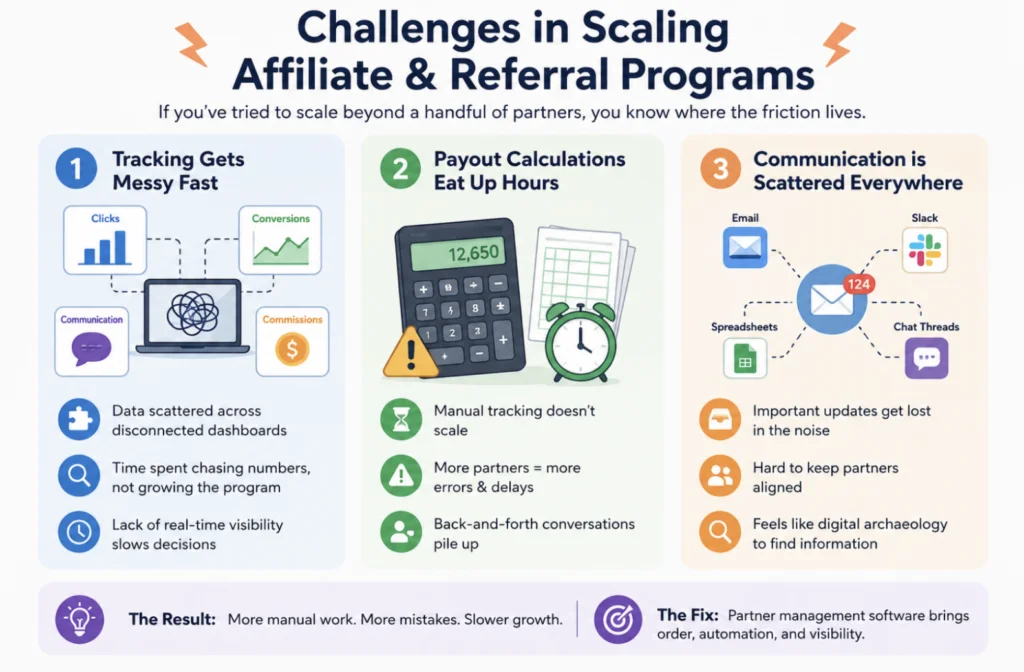
Scaling beyond a handful of partners reveals friction quickly. Tracking gets messy. Communication scatters across email chains, Slack threads, and random spreadsheets. Payout calculations eat up hours.
One expert in fast-scaling ecosystems explained that when attribution data and partner performance live in different places, you lose speed and confidence in decision making. Scaling breaks down when teams cannot trust or access a single source of truth.
This is where a centralized platform becomes essential. It brings order and automation to the messy corners of program management.
What partner management Software Actually Does
Partner management software gives teams one place to manage tracking, payouts, onboarding, reporting, and partner communication. No more stitching together disconnected tools.
The platform handles the operational side of partnerships. It tracks clicks and conversions. It calculates commissions automatically. It helps onboard new partners smoothly. It sends payouts on time. And it measures performance clearly.
The best platforms offer centralized tracking and reporting. They include automated payment processing. Onboarding tools and communication features keep partners in the loop. Performance analysis shows what is working.
How These Features Compound Over Time
Good tracking feeds clean reports. Clean reports inform smarter commission structures. Fair and transparent commissions keep partners invested. Easy onboarding means you can welcome many partners each week without scrambling.
Consider a team managing dozens of affiliates manually. They might spend 20 hours per week on administrative tasks. After implementing a dedicated platform, that time drops to nearly zero. The freed hours go directly into partner relationships and program optimization.
This pattern repeats across many software teams. Once payouts and reporting run themselves, you finally have time to coach partners, launch co-marketing campaigns, and test new incentives. That is where growth compounds.
Boosting Efficiency Through Automation
Software shines when the to-do list gets long. Onboarding new affiliates becomes a two-click process instead of a two-day project. Reporting and payments run automatically. You can analyze performance data without exporting CSVs and building pivot tables.
Automation removes the admin drag that slows teams down. It keeps partners moving and gives your team time to improve the program instead of babysitting it.
Many teams find that what used to take hours now happens automatically. Partner onboarding, commission calculations, and performance reporting all run on autopilot. That free time goes directly into strategic work.
Organizing Data for Better Decisions
As partner programs grow, data quickly becomes scattered across platforms and spreadsheets. A centralized dashboard pulls everything together. Clicks, signups, conversions, commissions, and campaign performance all appear in one view.
Teams can see what is happening in real time. They can identify top performing partners early. They can spot underperforming campaigns before wasting more budget. They can understand which traffic sources bring in customers who stick around.
That visibility matters because scaling decisions depend on accurate data. When the data stays organized, your program becomes easier to optimize and far easier to scale.
Empowering Partners to Succeed on Their Own
Strong partner programs are not built on payouts alone. Partners also need clarity and support. They need tools that make promotion easier.
Good software gives affiliates and referral partners access to dashboards, marketing assets, tracking links, and performance insights. They can do all this without constantly needing help from your team.
For instance, a creator promoting your software can log into their portal and grab marketing materials. They can generate tracking links. They can check their commissions anytime without waiting for manual updates. That independence keeps things moving faster for everyone.
The easier you make it for partners to succeed, the more likely they are to stay engaged and keep promoting your product.
Connecting with Warmer Prospects
Partner programs work because they create warmer introductions. Instead of discovering your product through a random ad, prospects hear about it from someone they trust. That changes the entire buying dynamic.
The software helps scale those trusted touchpoints by supporting personalized campaigns, accurate attribution, and smoother customer journeys across channels. It also helps teams understand which partner relationships generate the most qualified leads. Not just the most clicks.
That insight makes it easier to double down on partnerships that attract buyers who are genuinely likely to convert and stay.
Maximizing Return on Partner Investments
Once the engine runs smoothly, the question becomes how to get more out of every partner and every campaign. The answer involves a few key practices.
Recruit matched partners who align with your audience and sales motion. A niche blogger with 500 engaged readers who match your ideal customer profile will outperform a general publisher with 50,000 random visitors.
Set up proper tracking with clear attribution models. Understand first-touch versus last-touch insights. Handle cross-device journeys intelligently.
Track partner sourced LTV to CAC ratios. This keeps incentives aligned and helps you tune commission structures with confidence.
Test everything. Landing pages, offers, and commission structures. Small tweaks add up over time.
Imagine a brand that discovers a small group of niche creators consistently drives higher value customers than larger influencers with broader audiences. With the right visibility, the team can see which partners bring in repeat buyers. They can understand how each campaign contributes to revenue. They know which traffic sources convert into long-term customers.
That level of visibility makes it easier to double down on what works and cut spending on what does not.
Choosing the Right Platform for Your Team
The global market for partner relationship management software is growing rapidly. But there is no one-size-fits-all solution. Choosing the right platform is not just about features. It is about finding something that fits how your team works today while giving you room to grow tomorrow.
Start by picking a platform that matches your current stage. A startup running its first affiliate program has different needs than a company managing hundreds of partners across multiple regions.
Think about scalability. Your processes might work fine with 20 partners. Scaling to 200 is a different story entirely. The right platform should handle growth without forcing your team to rebuild workflows every time your program expands.
Check integration capabilities with your CRM and marketing tools. Disconnected systems create disconnected data. Good integrations help your platform sync cleanly with your billing software, email tools, and analytics stack.
Test the user experience carefully. If your team avoids using the platform, even the most advanced features become useless. The software should feel intuitive to both internal teams and external partners. Simplicity drives adoption.
Compare cost against the features you actually need. Not the ones that just sound impressive in a demo. If your team only needs tracking, reporting, and payouts, paying extra for advanced automation or enterprise analytics often adds little real value.
One expert in building scalable go-to-market systems explains that the software you choose directly shapes execution speed. You want clean integrations and fast onboarding for partners. You want pricing that stays sustainable as your programs scale. If those pieces do not align, growth usually gets stuck in operational friction.
A Forward Looking Perspective on Partner Programs
Affiliate and referral programs can be steady growth channels for any software business. The key is building them on trust, clear incentives, and clean data.
The right platform makes that possible at scale. It centralizes tracking. It automates payouts. It simplifies onboarding. And it surfaces the insights you need to invest in the right partners and the right campaigns.
For marketers looking to deepen their expertise in this area, exploring structured learning can help. Our affiliate marketing course covers the strategic foundations of building and scaling partner programs effectively.
Additionally, if you need hands-on support with your online presence, consider exploring our website design, search engine optimization, and digital marketing services with the famous trainer Nehme Sbeiti. These services are designed to help you implement the strategies discussed here and drive real results for your business.
The future of growth lies in partnerships. By automating the operational chaos, you free your team to focus on what matters building relationships that create lasting value for everyone involved.