Running a cleaning business means your work speaks for itself the moment you walk out the door. Getting someone to let you through the door in the first place is a different problem entirely, and that is exactly where social media for cleaning businesses either earns its keep or wastes your evenings.
You are probably already posting some before/after photos, maybe a review here and there, a shot of your kit before a big job. You get a handful of likes from people who will never call you, and nothing moves. The work is good. The posts look fine. But the calendar stays the same.
This guide is not about which platforms to join or how many times to post per week. It is about why before/after content and reviews work specifically for cleaning businesses in a way they do not work for most other industries, and how to build a simple weekly system around both that turns followers into actual bookings. If you are already posting and still not getting calls, the problem is not your content. It is what is missing around it.
Why Most Cleaning Businesses Post Without Getting Bookings
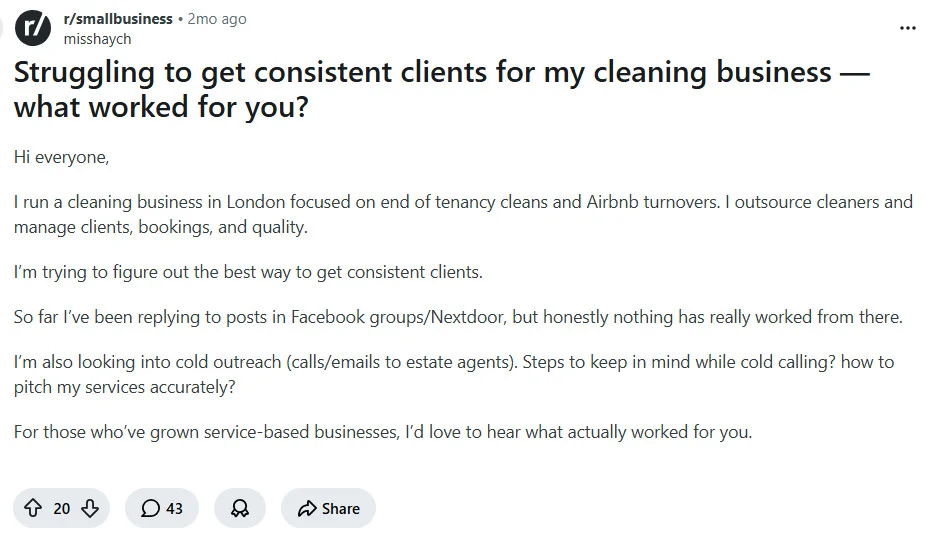
This question shows up constantly in small business communities. A cleaning business owner in London posted this on a popular small business forum two months ago and got dozens of replies. She is active, she is trying things, and nothing is converting. That gap is not a content problem. It is a system problem.
Social media activity and a social media booking system are two different things. Most cleaning businesses have the first without the second. You can have a strong social media presence and still have zero bookings if there is no location in the caption, no path for a viewer to take the next step, and no CTA telling them what to do.
Posting Activity vs. a Booking System: What the Difference Actually Looks Like
Here is what posting activity looks like: you share a photo of a clean bathroom, add a few hashtags, and wait. Here is what a booking system looks like: the same photo has your city in the caption, a direct call to action at the end, and a link in your bio going straight to a booking page. One is a photo. The other is a customer acquisition tool. The only difference between them is the framework you build around the content.
How Can Cleaning Businesses Choose the Right Social Platforms
For most residential cleaning businesses, Facebook or Instagram will generate more actual bookings than TikTok. Both platforms have older, more locally rooted audiences who are actively looking for home services. Start with one, get it working, then decide whether to expand.
Before Any Social Platform: Why Should You Create a Google Business Profile
Google Business Profile (GBP) is a free local listing that puts your business in front of people searching cleaning service near me before any social media profile does. Set up and verify your GBP before spending time on Instagram or Facebook. Fill in your service area, hours, photos, and a direct booking link. Everything you post on social media will eventually send people somewhere to book, and your GBP is the most direct destination for that traffic.
The One-Platform Rule and When to Add a Second
Give one platform 90 days of consistent posting before touching a second. Consistent means two to three posts per week, every week, with a booking path attached. If you are getting profile visits, DMs, and booking inquiries after three months, you can consider expanding. Before that point, splitting your attention makes both profiles worse.
Getting Your Profile Ready Before You Post on Social Media
Your profile is the first thing a potential client sees after clicking on your post. Before you publish another piece of content, make sure it answers three questions in under ten seconds: what do you do, where are you located, and how does someone book you. Make sure to add these four profile elements.
First, your name and bio must include your city and a one-sentence description. Residential house cleaner in Denver, CO. Recurring cleans, deep cleans, and move-out cleans. That is enough. Second, your link in bio should point directly to a booking page or scheduling tool. Third, use your face or your team in uniform as a profile photo, not a logo. Cleaning is a trust industry, and a real face builds trust faster than any graphic. Fourth, on both Instagram and Facebook, enable the direct message or booking button so a visitor can act when they land on your page.
Pinning Your Best Posts and Creating a First-Impression Content Set
Pin three posts to the top of your profile: your most dramatic before/after, your strongest client review, and a short introduction post or video showing you at work. These three posts answer the three questions every first-time visitor has: does this person do good work, can I trust them, and who are they.
What to Post: Content Pillars That Get Cleaning Businesses Booked
The content that drives bookings for cleaning businesses is not the same content that drives bookings for a gym, a restaurant, or a retail brand. Before/after content is any post showing the state of a space before and after your cleaning service. You do not need a professional camera or any special equipment. Use your phone, shoot in natural light, and stand in the same spot for both photos so the comparison is direct.
The before photo matters more than the after. A genuinely dirty grout line, a grimy stovetop, or a heavily soiled floor creates the kind of contrast that makes someone stop scrolling. A mildly untidy room with a tidy after is forgettable.
Why Before/After Content Works for Cleaning Businesses
Clients need visual proof before trusting a stranger with their home. A dramatic transformation is the closest thing to a test clean they can see without booking you. Before/after posts get saved and shared more than almost any other format in home services, which extends your reach without any additional effort. Location-tagged before/afters appear in local search results on Instagram and Facebook, putting your work in front of people in your service area who are actively looking.
Before/After Video and Reviews as Trust Content
Before/after video content on Instagram Reels consistently outperforms static photos for organic reach. Video captures the process in a way a photo cannot. Viewers see dirt being removed in real time, which is more convincing than a side-by-side still image. The format that drives the strongest engagement is visceral proof of the transformation: dirty before, clean after, shown in real time.
A five-star Google review that sits only on your GBP listing is a missed opportunity. Take that review, drop it onto a simple branded graphic in Canva with your logo, the star rating, and a short quote, and post it to Instagram and Facebook. This takes five minutes and turns something you already earned into a piece of trust content that reaches people who have never searched for you on Google.
Behind-the-Scenes and Process Content
Show yourself working. A short clip of you prepping your kit before a job, wiping down a surface in a methodical pattern, or packing out at the end of a shift builds a kind of trust that a polished transformation photo cannot. It shows a real person who cares about how they do the work.
How to Turn a Follower into a Paying Client
Great content attracts followers. A booking path converts them. Without a clear mechanism moving a viewer from liking a post to wanting to book this person, every post generates interest that goes nowhere. Before changing your content strategy, run through this first.
Make sure every post has location context. No city in the caption and no location tag means a viewer who wants to book you has no idea where you are. Every caption needs one instruction at the end: book via the link in our bio or DM us to check availability is enough. Find the grimiest surface before you start and lead with that. Add your first name, the neighborhood you worked in, or a one-line client reaction. This makes the post read as real work from a real person, not a stock photo from a faceless business.
The CTA Formula for Every Caption
End every caption with one action. Rotate between these options: book via the link in our bio, DM us to check availability in your city, or send us a message and we will get back to you today. One clear instruction gets followed. Three instructions get ignored. Your link in bio should go directly to a booking page, not your homepage. A homepage presents options. A booking page removes them.
What to Say When Someone DMs You
Speed matters. A potential client who DMs you and hears nothing back within a few hours will often contact a competitor instead. Keep this ready to paste into any inquiry: Hi Name, thanks for reaching out. I would love to help with your home in Area. My next available slots are Date and Date. You can book directly here at this link, or I can give you a quick call if that is easier. What works best for you? A quick reply with a clear next step will inspire them to take action.
The Batch Workflow That Makes Consistent Posting Realistic
Consistency for a solo cleaning operator does not mean posting every day. It means your profile looks active and credible when a potential client finds it. Two to three posts per week is the right target, and you can produce all of them in under 20 minutes once a week.
At every job, take three photos before you leave: the grimiest surface in the space before you start, the same surface after you finish, and one in-progress shot of you at work. Save everything to a dedicated folder on your phone labeled Content. That folder becomes your weekly post bank. Once a week, open your content folder, choose three photos, write three captions, and schedule them for Monday, Wednesday, and Friday. Each caption must have one sentence about the job, one line of context about what made it notable, and one call to action.
Close the Review-to-Social Loop in the Same Session
In the same batch session, check your Google Business Profile for any new reviews. Screenshot the best one, open Canva, drop it onto a branded template, and save it as your Wednesday or Friday post. Three minutes of work removes the I do not know what to post problem for at least one slot every week. At the end of the session, reply to any comments or DMs from the past week. A comment left unanswered for more than 24 hours signals unresponsiveness. Keep replies short and end each one with an invitation to book or ask a follow-up question.
What to Measure After 30 Days
The only social media metrics worth tracking in the first 90 days are the ones directly connected to bookings. Follower count and likes tell you about content performance, not business performance. Profile visits show how many people clicked through from a post to your profile to learn more. A post with high reach but low profile visits means the content was not compelling enough to generate curiosity. A post with lower reach but high profile visits means it landed with the right audience, even if it did not travel far.
Link clicks to your booking page is the most important number for a cleaning business. If profile visits are growing but link clicks are not, the issue is your bio or your booking page, not your content. Use the built-in analytics on your booking tool, or shorten your link to track click-through separately. Count inbound DMs and messages each week. If this number stays flat over 30 days of consistent posting, revisit your CTAs and your content types. Growing engagement alongside flat DM volume usually means you are creating content people enjoy but not content that makes them want to hire you.
If you want to take your digital marketing efforts to the next level, consider exploring resources on affiliate marketing or digital strategy. For professional guidance on website design, search engine optimization, and digital marketing services, the renowned trainer Nehme Sbeiti offers comprehensive programs that can help you build a sustainable online presence for your cleaning business or any other venture.
The businesses that consistently get booked through social media are not posting every day, running ads, or dancing on TikTok. They are posting two or three times a week, using before/after photos that show real work, turning every five-star review into a piece of trust content, and making sure every post has a location and a clear next step. That system is repeatable, it takes under 30 minutes a week, and it compounds over time. The future belongs to those who show up consistently and build trust one post at a time.