Choosing the wrong partnership tracking software can determine how long your company will survive. This guide compares Impact.com, PartnerStack, and Tapfiliate for startups to help you select the ideal solution for your stage of growth.
The developer logged out of the billing dashboard at midnight. The startup had spent $10,000 on custom partner tracking integrations. Yet, not a single affiliate had signed up. The runway was shrinking fast.
This scenario happens to founders every week. They buy heavy software before they are ready to use it. They assume expensive tools solve distribution problems. Instead, they get stuck in long setup loops and burn through their budget.
Quick Overview: Which Platform Wins for Startups?
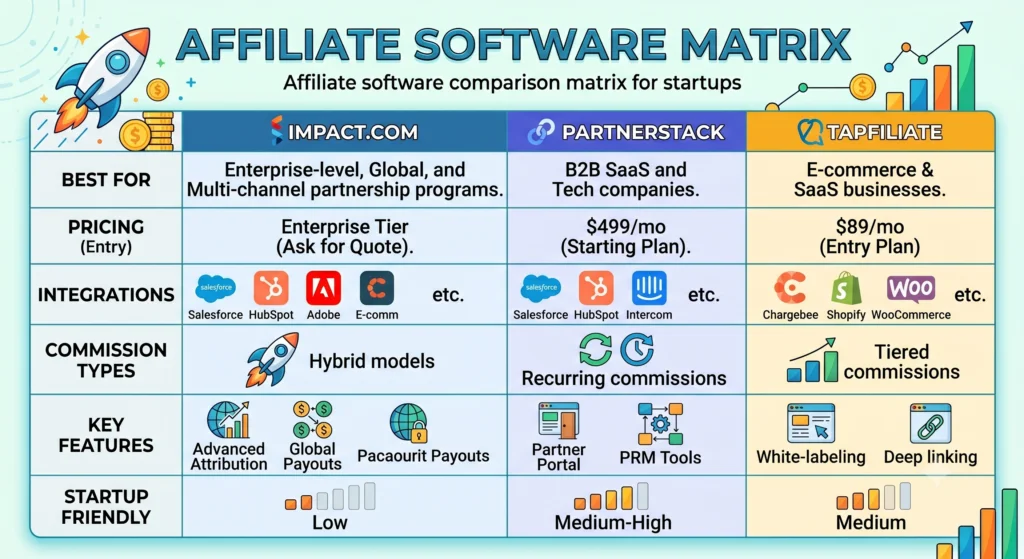
Tapfiliate wins for bootstrapped startups that need fast Stripe setups and flat rate pricing. PartnerStack is best for funded B2B SaaS teams ready to pay for a built in partner marketplace. Impact.com fits enterprise consumer brands managing global influencer networks with custom compliance needs.
You must align your partner tracking tool with your current stage. Overpaying for features you do not use wastes valuable cash and developer resources. Let us compare these three major players to find your perfect match.
Tapfiliate: Flexible Tracking for Growing Teams
Tapfiliate is a self serve platform built for speed. It launched to help small businesses track referral sales without complex coding. The software connects directly with payment gateways like Stripe. The dashboard is clean and easy to understand even for non technical team members.
It handles both subscription software and physical product sales effectively. You do not need a dedicated manager to run it. Setup takes less than an hour. The software does not have a built in affiliate network marketplace though. You must recruit your own affiliates and reach out to partners manually.
You can customize the affiliate portal to match your company branding. This ensures a seamless experience for your promoters. You can build custom registration forms to vet applicants before they join your program. The tracking uses first party cookies to bypass browser privacy blocks, ensuring accurate tracking even on modern devices.
PartnerStack: The B2B SaaS Ecosystem Powerhouse
PartnerStack focuses exclusively on the software industry. It helps B2B SaaS companies scale through resellers, agencies, and affiliates. Its biggest selling point is a marketplace of over 130,000 active partners who already sell software and understand recurring commissions. The platform integrates with major CRMs like Salesforce and HubSpot while automating complex payout routing across multiple currencies.
This power comes with high barriers though. The pricing is hidden behind sales calls. Onboarding requires dedicated developer help. The software tracks reseller leads through custom pipelines to prevent channel conflict with your direct sales team. You can provide training resources directly to partners. The platform handles global payouts automatically, calculating tax forms and paying partners in their local currency to reduce your administrative load.
Impact.com: Enterprise Grade Partnership Management
Impact.com calls itself a partnership cloud. It is a massive system designed to manage every type of brand relationship. It tracks traditional affiliates, media publishers, and social influencers. It has deep fraud detection tools and handles global tax compliance. The platform works best for retail giants with thousands of products. It offers deep attribution models to track multi channel customer journeys.
For a startup, this depth often turns into a major hurdle. The interface is difficult to learn. You will need extensive training to use it well. It provides a marketplace for influencer recruitment, but this database is geared toward consumer lifestyle brands. Finding SaaS partners here takes significant time. The software requires a complex integration process where you must place tracking pixels across your entire site, often requiring custom development work.
Developer Support Comparison
Tapfiliate uses a plug and play approach. You can install it using a simple JavaScript snippet or a WordPress plugin. If you use Stripe, you can sync the systems in a few clicks. Most users go live the same day without needing to coordinate with their support team. This speed keeps your team focused on product growth instead of technical configuration.
PartnerStack requires a structured onboarding process. A customer success manager guides your team. You must map out your partner tiers first. This setup often takes four to six weeks and requires developer hours to connect APIs and track custom billing events. If your startup lacks engineering resources, this delay postpones revenue generation.
Impact.com has the longest integration path. You will work with technical teams to configure tracking scripts. The setup can take up to ninety days. If you lack developer resources, Impact.com will stall your launch completely. Startups need immediate results, not long contracts or complex technical installations.
Recurring Payouts and Subscription Logic
Software startups need recurring tracking. You cannot pay affiliates a one time fee for a customer who cancels next month. Your software must track changes to monthly recurring revenue. If a user downgrades, the affiliate commission must be automatically reduced. Tapfiliate tracks recurring commissions natively. You can set rules for lifetime payouts or limit them to twelve months. The system updates automatically when payment gateways process subscription renewals, preventing overpayments to affiliates.
PartnerStack was built for this subscription cycle. It connects to Stripe, Chargebee, and Recurly. It handles upgrades and churn smoothly. It also supports reseller commission structures so you can pay different rates to partners who close deals directly. Impact.com can track subscriptions but it is less native. Its roots are in consumer e commerce. You must construct custom rules to handle recurring payouts, which increases complexity and risk of errors.
When you are building your marketing strategy, whether for AI tools, e commerce stores, or affiliate programs, having the right systems in place matters immensely. If you want to dive deeper into building a successful online business, you can explore our affiliate marketing course for structured guidance on creating profitable campaigns from scratch. You can also learn about website design, search engine optimization, and digital marketing services with the famous trainer Nehme Sbeiti to accelerate your growth journey with professional support.
Partner Marketplace Access and Recruitment
Tracking sales is only half the battle. You also need people to promote your product. PartnerStack holds a major advantage here. Their marketplace gives you direct access to B2B software promoters. You can pitch these partners inside the app. This access helps startups bypass the slow recruitment phase. These partners expect professional marketing assets and high payouts though. Tapfiliate requires you to recruit your own partners. You can invite your customers to join your program. You can also place signup links on your site. Recruitment takes time, but it builds loyal relationships with partners who genuinely care about your product.
Impact.com has a massive global network including large media companies and content creators. Finding software partners in their network is difficult though. The database is geared toward consumer retail. You will spend hours filtering out lifestyle influencers before finding relevant B2B targets.
Attribution and Multi Channel Tracking
Attribution determines which partner gets paid when multiple affiliates touch a sale. A customer might click an influencer link first then later click a coupon link. Tapfiliate supports standard attribution rules. You can select first click or last click models. This simplicity prevents tracking disputes. PartnerStack provides SaaS specific attribution that tracks leads from first touch to closed deal, protecting your reseller margins. Impact.com offers complex multi touch attribution where you can assign partial credit to different partners. This is helpful for huge budgets, but startups rarely need this detail. It increases administrative work and you will spend too much time calculating decimal payouts instead of growing your business.
Pricing and Total Cost of Ownership
Understanding the total costs of these platforms prevents early budget exhaustion. Tapfiliate offers flat rate pricing. You pay a predictable monthly fee with no surprise transaction costs or revenue share penalties. This predictability keeps your accounting clean. You can scale your partner sales without paying more to your software provider. A startup generating $50,000 in monthly affiliate sales pays under $150 per month on Tapfiliate. The software cost remains constant regardless of growth.
PartnerStack uses a revenue share model in addition to flat fees. They charge a percentage of your partner payouts plus platform fees. A startup can quickly find itself paying thousands of dollars monthly. This model works when margins are high but hurts bootstrapped teams significantly. Impact.com uses enterprise contracts with annual agreements. The pricing depends on your tracking volume and features. The initial cost is often too high for early stage companies. You may pay for features you will not touch for years. The onboarding fee alone can cost thousands of dollars. Startups should spend this cash on product development or user acquisition instead.
Frequently Asked Questions
How does Tapfiliate compare to PartnerStack? Tapfiliate offers an affordable self serve platform with fast setup for early stage teams. Unlike PartnerStack which focuses on premium B2B SaaS with a marketplace, Tapfiliate requires manual partner recruitment. This makes Tapfiliate much more cost effective for startups testing their first referral programs.
Is Impact.com good for B2B SaaS startups? Impact.com is generally not recommended for early stage B2B SaaS startups. It is an enterprise grade platform built originally for consumer retail brands. High pricing, long setups, and complex attribution are usually overkill. Early stage software teams just need simple referral links.
What is the best alternative to PartnerStack for B2B SaaS? Tapfiliate is a top alternative for B2B SaaS startups. It handles recurring subscription commissions natively and integrates with Stripe in minutes. While Tapfiliate lacks a built in marketplace, its flat monthly fees let you scale without paying revenue share transaction fees.
How much does PartnerStack cost for a startup? PartnerStack uses opaque sales led pricing that requires custom contracts. Startup programs often cost thousands of dollars annually plus transaction fees on payouts to partners. This premium investment is difficult to justify for pre revenue companies. In contrast, self serve tools offer predictable monthly pricing starting at under $100.
The right partner tracking platform can accelerate your startup growth or drain your resources. Choose based on your current stage and budget. Overpaying for features you cannot use yet only hurts your runway. Start simple, prove your channel works, then scale up when the time is right.