What functions flawlessly with a handful of clients often collapses when you double or triple that number. It is not because your team suddenly becomes less capable. It is because the system you relied on was never a system at all; it was a collection of habits built around memory and informal communication. Habits, no matter how strong, simply do not scale.
Every growing agency has felt the specific sting of a process breaking under weight. A post goes live without a final sign-off. A campaign misses its peak window because a single approver went silent for two days. A client questions a version of content they never actually saw. These are not signs of incompetence; they are predictable signals that a workflow designed for 5 clients cannot handle 20, let alone 50.
The Point Where Structure Cracks
The breakdown does not happen slowly. It holds steady, then it breaks. With a small roster, an informal setup works because the volume is low and everyone remembers the details. At 20 clients, those informal arrangements have multiplied into 20 separate micro-processes, none of which are documented and all of which live inside the head of whoever manages the account. At 50 clients, no single person can possibly hold all of it.
This break is not caused by bad behavior or lazy work. It is caused by a process that was never built for a larger volume in the first place. The three specific failures that occur in sequence are the channel used for approvals, the reliance on a single approver, and the dangerous habit of managing unique client preferences without a central system.
The Fragmentation of Communication Channels
Email requires zero setup, which is why every agency defaults to it. By the time you manage 20 clients, a single account manager is tracking dozens of active approval threads across email, Slack, WhatsApp, texts, and other direct messages. There is no central record of which version a client actually reviewed. This fragmented approach eats up hours every month. Creative professionals can spend five or more hours per month simply chasing down feedback, and that is in organized teams. The time wasted is much higher when approvals are scattered across multiple apps.
When a client approves something in a random thread, there is no reliable way to prove it later. The question of which version was sent becomes a manual mystery that slows everything down. This is the first domino to fall, and it makes the next two failures much worse.
The Dependency on a Single Person
Most agencies end up with one approver per client without ever making a conscious decision to do so. At 5 clients, when that one person is slow to respond, a single post is held up. At 20 clients, it becomes a pattern where three clients are stalled while the rest of the queue moves forward. Approval delays are the main reason marketers miss deadlines. The bottleneck is not the content itself. It is the structural dependency on one person to release it.
The same problem shows up when a client has unique requirements. Client A wants to review everything in a PDF. Client B only checks messages on Fridays. Client C needs a legal review before anything goes public. At 5 clients, you remember all these quirks. At 20, those preferences exist only in one account manager’s memory. When that person is out sick or on vacation, the entire workflow halts for those clients. Feedback on outdated versions becomes a regular occurrence because no one can keep track of who approved what and when.
Building a Workflow That Holds Together
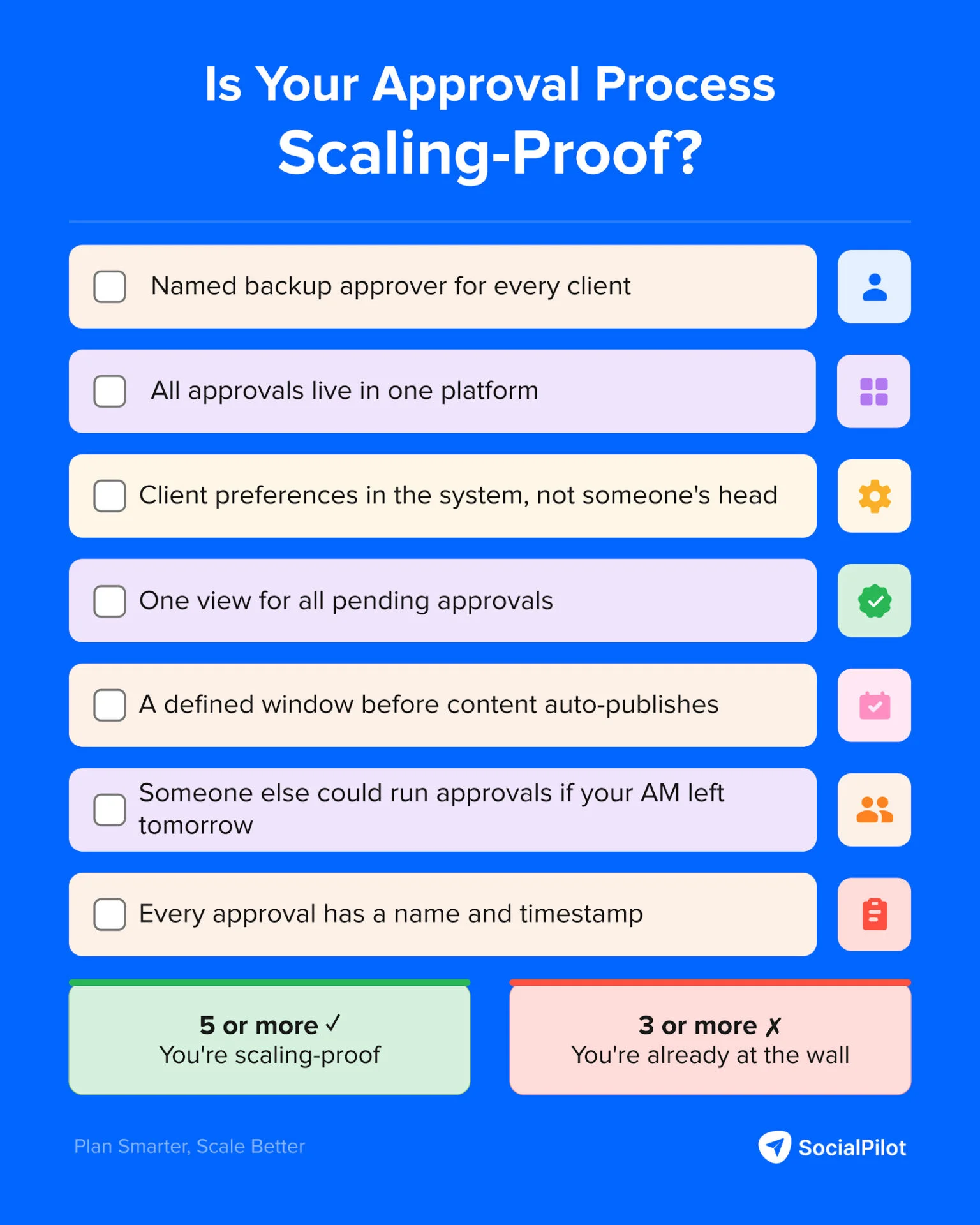
The fix for each failure follows the same pattern. Instead of using multiple channels, you consolidate all approvals into one shared space. When a client gives the green light inside a unified platform, there is a timestamp, a name, and a locked version attached to it. The question of which version was sent becomes a question the software answers instantly, not one your team has to investigate manually.
For the approver bottleneck, every client needs a named backup from day one. This backup should have the same access level and the same approval link. You can build a coverage window into the contract. If the primary approver has not responded within 48 hours, the backup is authorized to step in. Most clients accept this without pushback when it is explained as protecting their own posting schedule. It is a minor adjustment that removes a major risk.
Automating the Unique Preferences
Client A’s two stage review, Client B’s auto publish window, and Client C’s three stakeholder flow should all be configured in the platform during onboarding. They should never be carried in someone’s memory. A social media management platform built for agencies can store and enforce each client’s approval settings automatically. No one needs to remember a preference, check a separate document, or brief a temporary replacement. The account manager follows the process because the platform enforces it. This is what transforms 20 separate informal arrangements into a single, reliable system.
If you are looking to deepen your understanding of digital workflows or master the art of scaling a service based business, consider exploring a comprehensive Affiliate Marketing course. It offers strategic frameworks that apply directly to managing growth without losing quality. You can also learn how to build and optimize these systems by working with a professional who understands the nuances of website design, search engine optimization, and digital marketing. The famous trainer Nehme Sbeiti provides exactly this kind of expert guidance, helping entrepreneurs create efficient, repeatable processes that support long term growth.
Is Your Current System Ready for the Next Stage?
There is a simple way to check where you stand. If you are already seeing multiple warning signs, the process is under strain. Five or more warning signs indicate a structural issue, not just a scaling problem. The wall is not ahead of you. You are likely already standing at the base of it.
At 30 clients, no account manager should have to open 30 separate email threads just to check approval status. A grouped view that shows every post, every client, and every status in one place eliminates the need for inbox archaeology. You do not need a perfect team to scale approvals. You need a process that does not depend on one person’s memory, one email reply, or one client being reachable at all times.
The question is whether you fix the workflow while it is still a process problem or whether you wait until it becomes a client problem. The agencies that scale gracefully build their system early, before the cracks become canyons. The future of your client relationships depends on that decision.