It was a Monday that started like any other. Maria glanced at her Salesforce dashboard and spotted a clean, respectable revenue line. Then her CEO leaned over and asked a single question that stopped her cold. “Which affiliate drove that particular deal?”
She had no answer. The numbers looked perfectly accurate in the pipeline. Yet the attribution behind every single dollar had simply vanished into thin air. Somewhere between a creator’s referral link and a closed deal, the credit disappeared entirely.
That exact moment of panic is why more teams are searching for a smarter way to connect their affiliate data directly to their CRM. This blind spot costs companies real money, and most don’t even know it exists until they get that same question from their boss.
What an affiliate tracking connector actually does inside Salesforce
A connector acts as a dedicated bridge between your affiliate platform and your CRM system. It moves referral data like clicks, customers, and conversions onto the records that your sales team already reads every single day. One side of the bridge records the original affiliate event. The other side files that information neatly inside your Salesforce account.
Without that bridge working for you, affiliate data sits locked away in a completely separate tool. Your sales reps see deals closing, but they never see the partner who started the entire chain of events. In my experience running these setups, this is exactly where programs quietly start to bleed money. The data exists somewhere, but it never reaches the people who set the budgets and make the strategic decisions.
Why Salesforce cannot see affiliate conversions all by itself
Salesforce operates as a system of record. It stores leads, contacts, and opportunities with excellent discipline and structure. But the platform does not watch your website for referral clicks. It has no idea about an affiliate cookie that fired three weeks ago while a customer was browsing at midnight.
What I have noticed over and over is that marketing teams naturally expect their CRM to automatically attribute every single referral. It simply cannot perform that job on its own. That responsibility belongs to a tracking layer that was built specifically for handling affiliate events and payment logic.
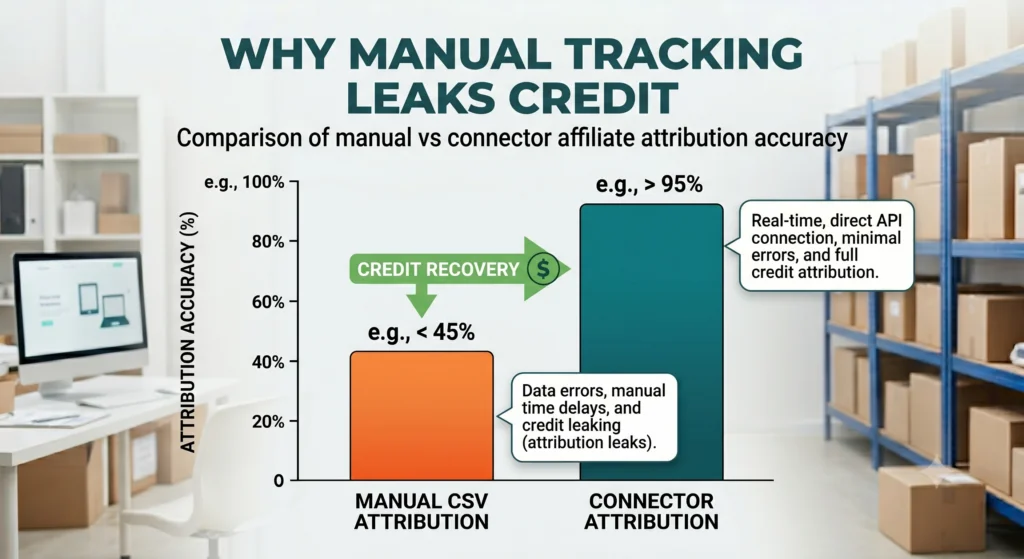
Let me describe the workaround that almost everyone tries first. Someone exports a CSV file every Monday morning. They paste affiliate IDs next to deal names using nothing but their own eyes and a steady hand. That spreadsheet gets reopened weekly, it grows heavier, and eventually it breaks. One single typo can end up paying the wrong partner the wrong amount. The real question then shifts from how to report on affiliates inside Salesforce to which tool captures the conversion event before Salesforce ever even sees it.
How the connector layers work together for conversion tracking
Here is the crucial pivot that most guides tend to skip completely. Your connector is only as good as the ledger that feeds it accurate information. That ledger records conversions as a dedicated layer, then it hands clean, structured data to your CRM. This matters deeply because the conversion event is where money gets decided. Get that event wrong, and every single downstream report inherits the exact same error.
The role of conversion and commission records
When a referred customer takes a meaningful action like signing up, making a one time purchase, or paying for a subscription, the conversion gets recorded immediately. Each conversion ties directly back to the specific affiliate who earned it. The system stores the click ID, the customer details, and the transaction amount together in one safe place.
Commissions live in that same ledger system. You attach a commission to a conversion, then you update its approval status as deals clear or get disputed. This part is what rivals often gloss over in their explanations. The tracking layer is not just a pass through pipe for data. It is the accounting brain that decides exactly who gets paid and how much they earn.
Recurring revenue is where this setup really stands out from the crowd. For subscription based businesses, every single renewal stays attributed to the original referring affiliate. You configure this logic just once. A creator who referred a customer in 2024 still earns a commission on that same customer’s renewal payment in 2026. No manual rematching is needed. No lost credit ever happens.
The sync layer that pushes data into your CRM
Once the system owns the conversion event, the connector pushes it outward toward your CRM. This is the second critical job of any affiliate tracking connector. Through a workflow automation tool, triggers fire on real events like a new conversion, a new customer, or a new payment. Each trigger can create or update a CRM record. A conversion becomes a lead. A customer becomes a contact. A booked sale becomes an opportunity.
Data can move in both directions too. A new CRM contact can create a customer record in the tracking system, keeping both platforms aligned without anyone needing to enter the same information twice. The result is straightforward and powerful. Your sales reps open their CRM dashboard and see the affiliate behind every single deal, complete with dates and performance scores.
A comparison of different affiliate tracking approaches
Not every tool fills the same gap for your business. Some track UTM tags and nothing more. Some manage WordPress plugins for lead gen sites. Few tools actually own the full conversion ledger that stores commissions and handles recurring payments. UTM tools will tell you that a link was clicked. A proper connector tells you whether a commission was actually earned and paid out.
That difference decides whether you can pay your partners with total confidence every single month. If you are serious about building an affiliate program that scales, you need the deeper layer of control that comes from owning the conversion event itself.
For those looking to master the full strategy behind building a profitable partner program, my online course on Affiliate Marketing covers everything from choosing the right tracking setup to scaling your payouts without losing control. You can also explore professional guidance in website design, search engine optimization, and digital marketing services with the experienced trainer Nehme Sbeiti to ensure every piece of your online business works together smoothly.
Best practices for keeping conversion tracking accurate
A connector only helps you if the data going into it stays clean and reliable from the start. These habits keep your attribution honest and your payouts accurate. Tag every affiliate link with consistent parameters. Mismatched tags can split one affiliate into three phantom identities that confuse your reports. Deduplicate conversions before they ever sync into your CRM. One refund or one double fired event can inflate a payout faster than you expect.
Confirm your recurring commission logic early in the process. Decide whether renewals pay the original affiliate or reset for a new referrer, and test that logic with real customer dates. Reconcile your approval status on a weekly basis. Approve cleared deals, hold disputed ones, and let your connector update the CRM to match the current state of affairs. Picture the real cost of skipping these steps for a moment. A program that pays two hundred affiliates with just five percent of conversions double firing represents a real margin leak happening every single month.
Now picture the upside instead. Clean attribution means your partners trust their payouts completely. They refer more customers. Your pipeline compounds quietly in the background while you focus on growing the business.
Bringing it all together for your team
Maria’s problem was never actually Salesforce itself. It was asking the CRM to perform a job it was never designed to do. Salesforce records the deal once it happens. The conversion event belongs upstream inside a dedicated tracking layer that understands affiliate logic and handles payments. Connect the two systems properly, and that Monday morning question gets a one click answer. The affiliate behind every single dollar sits right inside the record where your revenue team already works every day.
This approach turns a blind spot into your program’s greatest strength. Every partner gets credited accurately, every payment flows smoothly, and your team finally sees the full picture of what their affiliate program is really accomplishing.