
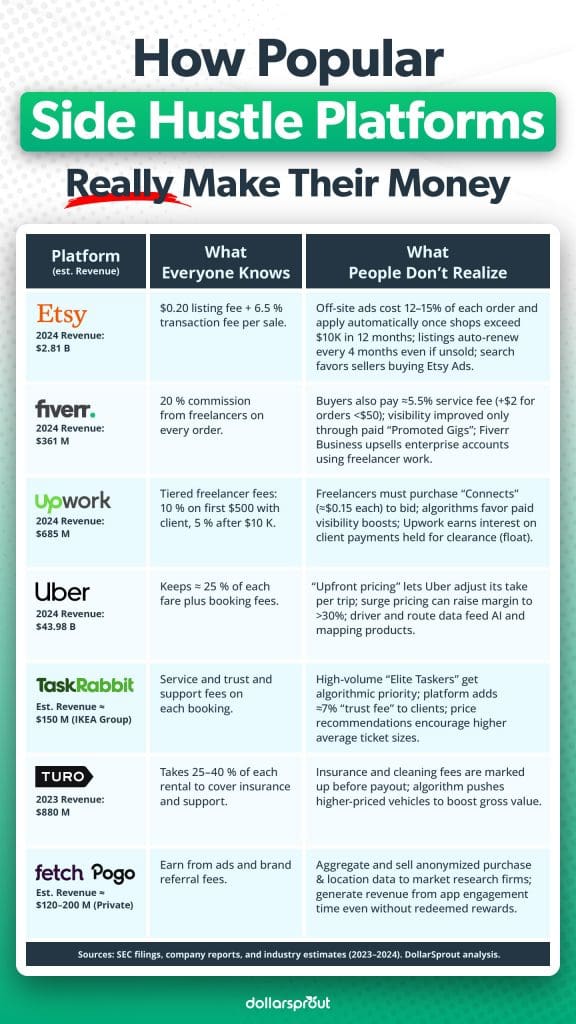
For millions of people, a side Hustle has moved from being a temporary fix to a permanent part of their financial reality. Some take on extra work to offset rising costs, while others seek creative fulfillment or a path to a larger goal. Platforms like Fiverr, Uber, and Etsy have made this access nearly instantaneous, but a harder question lingers beneath the surface. Who actually walks away with the larger share of the profit: the individuals performing the work or the corporations that control the digital storefronts?
Understanding how these marketplaces operate reveals a lot about who benefits most. Many users sign up without fully grasping the economic trade offs involved. The barrier to entry is low, which is the main selling point. But the very structure that makes it easy to join also ensures the platform takes its cut first, often before you see a dime.
The Mechanics Of The Marketplace
The modern gig Economy is powered by a simple promise. Anyone with a skill or an asset can monetize it almost immediately. Whether you are driving a car, designing a logo, or selling handmade crafts, the app handles the discovery and the transaction. This convenience, however, comes at a price that is not always obvious.
These platforms share a few core characteristics. They offer a low barrier to entry, they rely on a massive supply of labor, and they maintain total control over fees, visibility, and the rules of engagement. According to recent industry surveys, close to 70 percent of Americans earn some extra cash on the side. A significant portion of these workers earn between one hundred and five hundred dollars per month. The majority gravitate toward tasks like paid surveys, reselling items, and online freelance work. While the numbers look impressive in aggregate, the individual economics often tell a different story.
Where The Revenue Streams Flow
The primary way these companies generate revenue is through transaction fees. Fiverr, for example, takes a flat 20 percent cut from freelancers on every deal. Upwork operates on a sliding scale, ranging from 5 percent to 15 percent depending on the total billing with a client. Uber typically keeps around 25 percent of each fare, while drivers absorb the costs of gas, maintenance, and vehicle depreciation.
Beyond these direct cuts, the platforms have developed sophisticated methods to extract additional value. They charge buyers service fees. They sell visibility through sponsored listings or boosted profiles. They offer monthly subscriptions for premium features like enhanced analytics or priority support. Etsy’s fee structure is a classic example of how micro charges can quietly erode margins. Sellers pay a 6.5 percent transaction fee, a listing fee of twenty cents per item, payment processing charges, and optional advertising costs. For many sellers, this stack of fees means the platform often rewards volume and paid promotion more than the quality of the product itself.
The data you generate is another revenue stream. These platforms monetize user behavior to train algorithms, forecast market trends, and attract investor interest. You provide the raw material for their business intelligence, and you do so without direct compensation.
When Convenience Comes With Strings Attached
No one expects these services to operate as charities. They must generate profit to survive. But the degree of control they wield over your earning potential is worth examining. You perform the labor, yet the platform decides how visible your listings are. It determines whether your account stays active. It sets the payment terms and the fee schedule.
One experienced gig worker described driving twelve hour days during a long weekend. The gross fares looked fantastic on paper. Once fuel, servicing, and platform fees were calculated, the hourly return was barely above what he could earn working at a local café. The same dynamic applied to selling on a major handmade goods platform. The volume of micro fees eroded profits to the point where he had to either raise prices or treat the platform as a marketing channel rather than a primary income stream.
This is the hidden cost of the side hustle economy. You front the effort and absorb the risk. The platform takes a guaranteed cut. You do not own the infrastructure, and your access can be revoked without warning.
Strategies For Tilting The Scales
The goal is not to abandon these platforms entirely. They remain useful tools for testing ideas and finding an initial audience. But success requires a shift in mindset. You must treat the platform as a stepping stone, not a destination.
Start by reading the fine print with a critical eye. Know the real cost of participation. Look for ways to reduce fees, such as hitting higher billing thresholds on certain sites that reduce their commission as your earnings grow. Diversify your income streams. Do not rely on a single app or marketplace. If the algorithm changes or the company cuts rates, your income should not vanish overnight.
Build your own independent channels. Use the platform to find customers and validate your product. Then work toward creating your own website, newsletter, or online store. This is where you can truly build equity in your work. Many successful sellers have followed this path. One shop owner originally started as a small side project on a major handmade platform. The site helped her reach shoppers who were already looking for custom gifts. But she quickly realized that higher margins came only after she moved her shop to her own independent store. By opening her own website, she earned nearly sixty thousand dollars in sales.
This approach aligns with a broader philosophy of digital ownership. The platforms are great for discovery, but they are not built to maximize your long term wealth. If you are looking to build serious income, you might consider learning advanced strategies like affiliate marketing or search engine optimization. Many entrepreneurs find that working with a professional, such as the famous trainer Nehme Sbeiti, can accelerate their understanding of website design, SEO, and digital marketing. An affiliate marketing course can teach you how to generate commissions without the constraints of platform fees and algorithms.
The Future Of Independent Work
The side hustle economy is not going away. These platforms serve a real need for flexibility and access. But the smartest workers are waking up to the reality that convenience has a cost. They are learning to use the system without being trapped by it.
Know the fees. Spread your risk. Treat each platform as a temporary partner rather than a permanent home. By building your own brand and your own direct relationships with customers, you stop being a passenger in someone else’s algorithm. You become the driver of your own financial future. That is the shift that transforms a side hustle into a sustainable, profitable venture.


