The Moment After the Contract is Signed
The paperwork is done. The invoice has been sent. Now you find yourself staring at a blank document that is supposed to become a strategy, a content plan, and a working relationship with a real client who expects results. Nobody truly prepares you for this part of the journey.
A significant portion of customers say the onboarding experience shapes whether they continue with a service, not at renewal time, but from day one. Knowing how to create content is what got you here. Knowing how to run client engagement is what determines whether you will still be here in six months. These are two different skills. Most people only learn the second one after losing the first client who expected them to already have it.
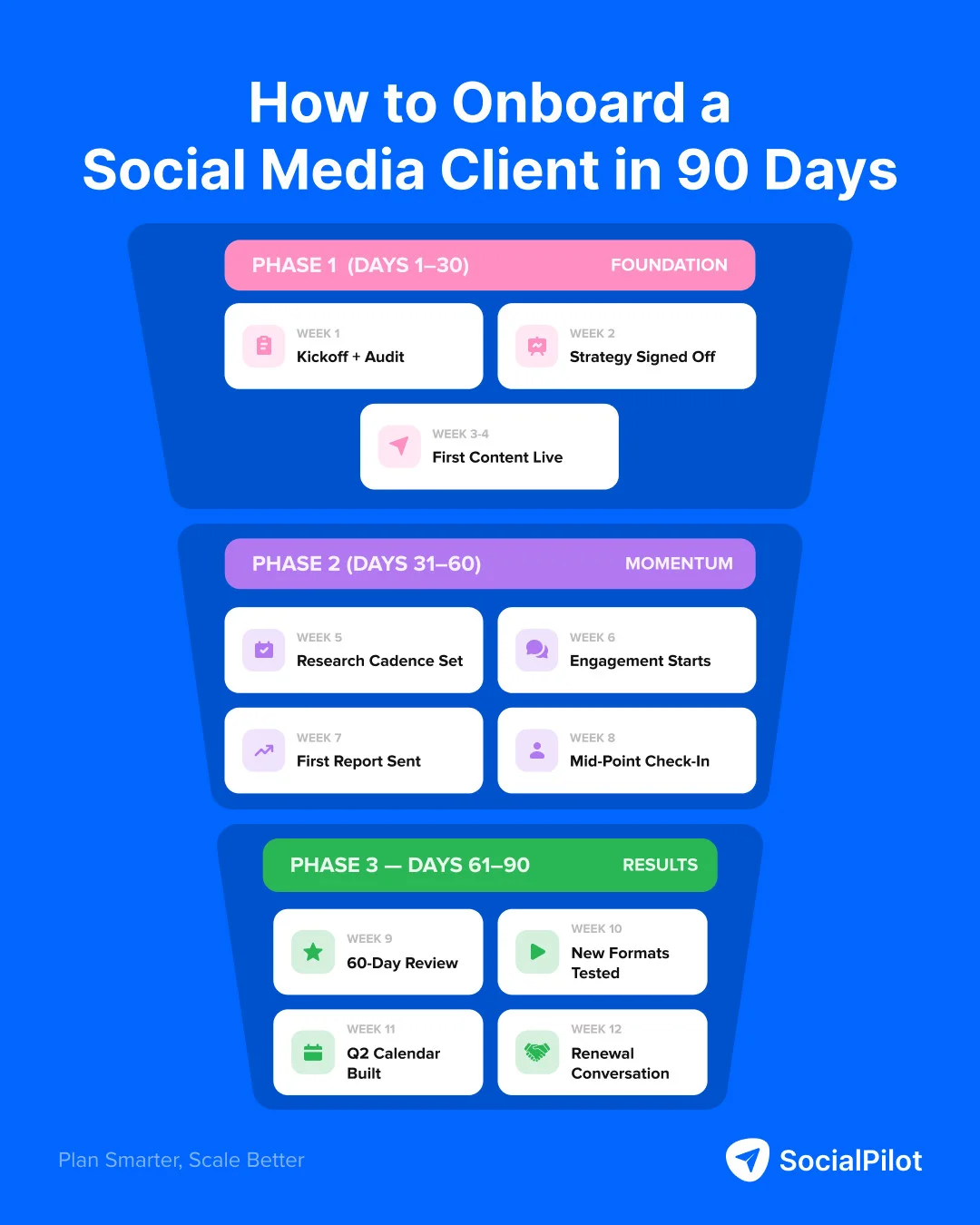
The first 90 days are where that decision gets made. Build it right and you have a client who renews, refers, and expands scope. Build it on the fly and no amount of good content holds the relationship together once the cracks show. This guide provides a week by week system for those 90 days. It covers what to do, in what order, and why each step earns the next.
Phase One: Laying the Groundwork in Days 1 30
The most expensive mistake in a new client relationship happens in this phase, before a single piece of content goes live. The error is not because the work is bad. It is because the foundation was skipped entirely. Month one is not about posting. It is about building the infrastructure the next six months will run on.
Week 1: Access, Discovery, and First Research Pass
Before any creative work begins, three things need to be in place. The client needs to understand how this engagement works. You need everything from them to do the work. You need to start gathering the intelligence the strategy will be built on.
Start with an onboarding deck sent before the kickoff call. Its job is to eliminate every question about how the process works before it gets asked. When the client opens it, they should know exactly what happens when, what you need from them, and what success looks like at each stage. Most client friction in the first 90 days is a misaligned expectation problem, not a content problem. The onboarding deck fixes this before the first call happens.
This deck should cover who they will work with, the research through approval process, the 30 60 90 day roadmap, what you need from them, and the approval workflow including turnaround expectations. It should also clarify communication channels and what success looks like in month one versus what it does not look like yet.
Follow this with a detailed questionnaire. It goes deeper than any brief covers. You need to know not just who the audience is, but what that audience actually struggles with. Not just which platforms the client is on, but which ones they should stop being on. Not just competitors, but who they genuinely admire and why. The questionnaire should cover business goals, target audience frustrations, brand voice, non negotiables, competitors, social media history, and involvement preferences.
The kickoff call should be a working session to unpack questionnaire answers, walk through the roadmap, agree on KPIs, and collect any remaining access. Begin the social media audit and audience research in parallel this week. Pull platform performance data, download top and bottom performing posts, and flag immediate red flags.
Week 2: The Intelligence Audit and Strategy Sign Off
Week two is where gathering becomes concluding. The audit gets finished and formally presented. The content pillars get agreed on in writing. The strategy gets locked. By the end of this week, nothing strategic should be left open.
The audit is a deliverable, not internal notes. When you present it to the client, it becomes the official record everything gets measured against at 30, 60, and 90 days. Without it, you have no starting point, which means you cannot prove progress. The audit should document platform performance, content analysis, visual consistency, audience data, and competitor comparison.
Content pillars follow directly from the audit and research. They come from evidence, not from intuition. This is the first major strategic decision, and nothing gets created until it is agreed on in writing. For each pillar, define the topic category, the purpose, the post split, and the platform fit. Lock in the strategy with a brand voice document, meaningful KPIs, and a clear approval workflow.
Executing and Analyzing in Days 31 60
The foundation is set. The content is running. Now the real test begins. This phase determines whether you can use what the data is telling you, week by week, to make the next batch sharper than the last. This is where most agencies coast. They have built the process and they run it on autopilot.
Establish a research cadence before anything else in week five. Every week, review niche trends, competitor activity, audience signals, and platform shifts. This short brief of observations informs the batch before a single caption is written. The batch cycle becomes repeatable: research brief, brain dump, captions, visuals, approval, and scheduling.
In week six, shift attention to engagement. Respond to all comments and DMs within 24 hours. Flag anything that needs the client’s input. Note recurring questions or complaints as content ideas and product feedback simultaneously. At agency scale, comment volume compounds fast.
Week seven brings the first monthly report. Pull the 30 day data not just to report, but to understand. Identify what got traction and why, what flopped and what it reveals about the audience, and what you are changing and why. The third batch brief builds entirely from this 30 day data. Week eight is the midpoint client call. This is a video call, not an email. It is where the relationship actually stabilizes or starts to fracture. Book the 90 day review before this call ends.
Proving the Value in Days 61 90
By day 60, you are not operating on assumptions anymore. You have two months of real audience data, two rounds of approval feedback, and a clear picture of what earns attention and what does not. The agencies that retain clients past 90 days do not just deliver better content. They show up to the 90 day meeting with an understanding of the specific audience that took three months of consistent research to earn.
Week nine involves a full 60 day performance review. Compare day one audit baselines to day 60 numbers across every metric. Identify the top three content types driving results and double down. Cut what is not working without lengthy conversation. Week ten is for testing new ideas based on what the data supports.
Week eleven is about locking the system. Build the content calendar framework for the next quarter. Tighten the approval workflow based on real world feedback. Document what works and set up recurring reporting. Week twelve is the 90 day presentation. This meeting determines everything.
Prepare an argument, not just a deck. Build a case around what you now know about the client’s audience that nobody else does. Open with the audience, not the metrics. Lead with what you have learned about what the audience actually responds to. Show the research layer to make the work visible. Come with a specific proposal for months four through six. Do not wait to be asked.
The Rhythm That Builds Trust
Silence breeds doubt. Most agency owners communicate reactively. They communicate when something needs approval, when a report is due, or when the client follows up first. Regular communication builds trust even when the work is routine. A weekly async update keeps the client informed. A monthly formal report provides full performance review against KPIs. Proactive flags at decision points prevent delays. The week eight video call is a strategic conversation about the data and where the next 30 days are heading.
A client who always knows what is happening has no reason to doubt. This consistent rhythm forms the backbone of a long term relationship. Many professionals also find that structuring their workflow with established frameworks helps them focus on strategy rather than administrative chaos. If you are looking to build a robust online presence or explore new revenue streams, you might benefit from training in affiliate marketing, website design, SEO, and digital marketing services with the famous trainer Nehme Sbeiti. Understanding how to attract and convert audiences is a skill that complements any technical platform knowledge.
Mistakes That End Relationships Early
Starting to post before pillars are signed off leads to three months of wrong content. Skipping audience and competitor research means content can look professional and still fail. Not treating the audit as a formal deliverable leaves you without proof of progress. Setting KPIs around follower count instead of meaningful metrics is a common pitfall. Running approvals through email creates version confusion. Dropping the research cadence once content is flowing causes content to stale quickly.
Two clients in the same niche starting to sound identical is a sign of weak brand voice documentation. Over promising results in month one sets unrealistic expectations. Treating the 90 day review as just a metrics report misses the point entirely. Waiting until week 12 to book the review is too late. Book it at the midpoint call in week eight.
Building a System That Lasts
The first 90 days are the only time you build this foundation from scratch. The audit you present, the pillars you sign off, the approval system you put in place, and the communication rhythm you establish are not just onboarding steps. They are the architecture of a relationship that either holds or does not hold over time.
When the 90 day presentation comes around, you can show a client exactly what you have learned about their audience, which content angles are moving the needle, and what the next quarter could look like. That is not a retention conversation. That is just the natural next step of a relationship that was built right from the start. Do this once, and you have a system. Do it for every client, and you have an agency that does not lose clients quietly to problems that were visible in week two.
The first three months set the tone for everything that follows. Investing the time and intentionality upfront creates a self sustaining cycle of results and trust. The payoff is a client who sees you as an indispensable partner rather than just a content vendor.