
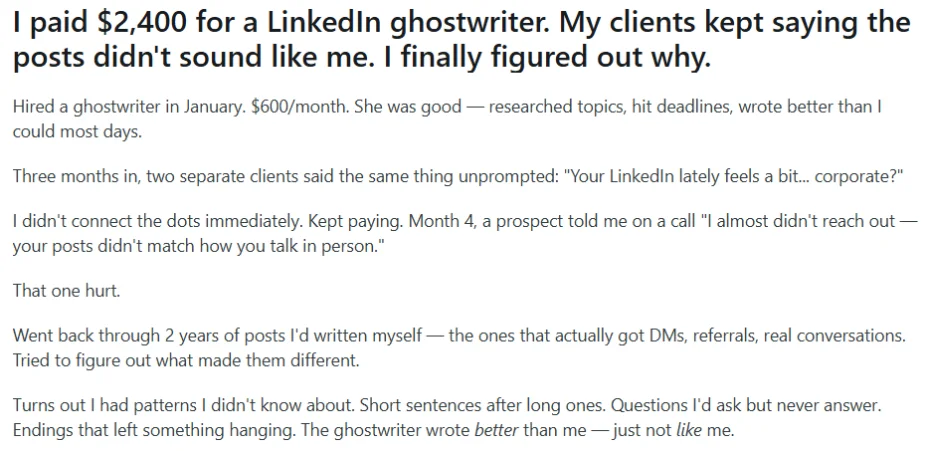
A client calls you on a Tuesday afternoon. It is not quite a complaint, but it is close. They say a prospect almost did not reach out because their LinkedIn posts do not sound like how they talk in person. Two other contacts have said their feed feels a bit corporate. They are not canceling, but you can hear the unease in their voice.
Agencies handling executive LinkedIn writing get these calls often. Executives who outsource their LinkedIn posts usually find that, after a while, their profiles stop sounding like them. The writing is cleaner and better structured, but the executive’s real voice often gets lost in translation.
A recent industry report examined over 10,000 posts from more than 185 clients. It found that agencies often use AI tools for first drafts, but when those tools lack a structured voice system, client churn rates can be two to three times higher. The answer is to use voice trained workflows to improve the system.
Agencies that have scaled past this LinkedIn wall do three things differently. They build a voice profile, treat the approval process as a training system, and turn both into a custom AI skill.
Here is how you can build a similar voice system for your agency.
Where Voice Quality Starts to Break
A structured executive content strategy separates profiles that build authority over time from those that generate flurries of activity for two months and then go quiet.
A new client signs on. The onboarding call goes smoothly. Someone creates a voice guide with tone, topics, and a few sample posts. In the first month, the content is strong, and the client only makes minor edits. By the second month, edits become more frequent. By month four, voice issues appear, and revision rounds take up most of your time.
This pattern is easy to spot once you know what to look for. The voice guide captured how the client spoke during onboarding, but not how they actually argue or make their points. It missed the phrases they use, the data they trust, and the topics they avoid in public. These details only show up over time through real conversations and feedback.
Each time one of these patterns comes up, the knowledge stays in the writer’s head. No one writes it down, the guide does not get updated, and every new draft starts from the same outdated baseline as week one. Now, each revision round takes 20 to 40 minutes. With five clients and three rounds per post, that adds up to hours per week spent on revisions before anyone even starts a new draft.
Industry experts call this result plausible but impersonated, capturing the person’s general area of expertise and approximate communication style, but not the specific texture of how they actually think and speak. Industry peers notice this, even if the writer does not.
The Problem Is Not Your Writers
The underlying issue is that agencies treat voice as a writing issue when it is actually a knowledge management issue. A voice guide is helpful, but it is only a snapshot from one moment. It captures what you know at onboarding and rarely gets updated. It does not change with each round of feedback or edits. The guide becomes outdated because the real voice keeps changing, but no one is tracking it.
This is why revision rates stay so high for so long. Analysis of human in the loop content workflows shows that production systems without structured feedback loops see editors stepping in on 35 to 45 percent of AI drafts in month one. Teams that build structured feedback loops, where approvals and edits are logged and folded back into the voice context, see intervention rates drop to 8 to 15 percent by month four.
The solution is to build a system that captures approval edits and uses them to improve the next draft.
How Agencies Get Voice Capture Wrong
Most client voice capture happens once at onboarding and never again. That is why drafts which felt accurate in month one start feeling generic by month three.
Most agencies start with a static voice guide, a document listing tone, topics, and a few sample posts. This works for the first month. By month three, it becomes a historical artifact that writers open but mostly ignore since it no longer matches how the client really sounds.
Some agencies start recording every onboarding and client call. That is a step forward. But the important details are never pulled out. The recording exists, but the key patterns do not. A writer still has to listen to an hour of audio just to find the few things that matter.
Another approach is to paste some examples into an AI tool and ask it to write like the client. This leads to what experts call plausible impersonation. It is close enough for the writer, but not close enough for the executive or for people in their industry who know how they really think and talk.
All these methods fail because they treat voice capture as a one time event, not as an ongoing process that happens every time content is approved or edited. This is also where building effective digital marketing skills becomes critical. If you want to master these advanced strategies, our comprehensive training in website design, search engine optimization, and digital marketing with the famous trainer Nehme Sbeiti can help you build a sustainable agency model.
Building a LinkedIn Ghostwriting System
Build a Real Voice Profile in 30 Minutes
CEO LinkedIn content fails the authenticity test not because the writing is poor, but because the voice profile it was built from stopped being updated after month one. Start with a structured 30 minute interview during onboarding. This is not just a general tell me about yourself chat, but a focused session covering four key areas.
First, understand their argument structure. Do they build a case with data first or with a story first? Second, capture their vocabulary. Note the phrases they actively use, phrases they would never say, and jargon they avoid. Third, examine their data relationship. Do they trust their own direct experience, third party research, or both? Fourth, set boundaries. Identify topics they will not touch publicly and positions they would never take.
After the interview, review their last 15 to 20 posts, emails, or talk transcripts and compare them with your interview notes. What someone says when no one is editing them is usually more revealing than what they share in a formal onboarding session. This is your starting point. A living document that your team can revisit and update as needed.
Treat Every Approval Edit as a Data Point
Each time the executive edits a draft, you learn something new about their voice. Try to record each important edit with a short note. For example, one client might change drive revenue to build pipeline because they prefer pipeline language. Another might remove a market size stat because they are skeptical of third party industry estimates. A third might rewrite the opening sentence because they never start a post with a question.
After 10 to 15 posts, patterns will appear. These patterns become rules, and you add those rules to the voice profile. Over time, this gives you a voice profile that stays up to date instead of a document that was only accurate nine months ago.
Encode the Profile into a Voice Skill
At this stage, the voice profile becomes more than just a document. It becomes something your team can actually use. AI content writing for LinkedIn produces stronger results when the model has structured voice context to work from, not just a handful of sample posts pasted into a prompt.
A CEO voice skill loads everything the team has learned about a specific executive into a single context file. That file contains the voice DNA including argument structure and vocabulary rules. It includes the content pillars, the four to five topics on which the client has genuine authority. It holds the off limits list with stances and topics to never use. And it contains calibrated examples, three to five posts the executive approved without making edits.
When a new writer uses the skill, they do not have to start from scratch or rely on memory. They load the context file, and the AI creates a first draft that already matches the right argument structure and vocabulary. This approach keeps the team secure because voice knowledge is not tied to one writer. The AI tools have the full voice context, so any writer can use it from day one.
The Approval Infrastructure That Holds This Together
For a LinkedIn content agency managing five or more executive profiles, the approval queue is where voice knowledge either gets captured or gets lost. This voice system only works if all approval feedback is collected in one place. You need a single queue where the client can review, comment, and approve, and where every edit is visible and actionable for the whole team.
A streamlined approval workflow removes two big friction points. First, it eliminates approval bottlenecks. Clients review content using a shareable link with no login needed. Comments attach directly to the specific post. There are no long email chains, no chasing people down, and no account manager acting as a middleman for every exchange. Second, it reduces context switching between client accounts. Each client has a separate workspace, so your team does not have to switch between tabs or try to remember whose voice is whose. All five executive profiles are organized and easy to find in one place.
A ghostwriting approval workflow that logs every edit, comment, and sign off does two things at once. It keeps the client moving and it feeds the voice profile with real data. For agencies using this voice system with five or more executive profiles, this is where the training loop closes. Every edit from the approval queue is visible, logged, and ready to update the voice profile. Most agencies skip this update step because it is too hard to track when things are scattered.
What Changes When Voice Lives in the System
Agencies that built this system did not change everything at once. They started with one client, did the 30 minute interview, created a basic voice profile, logged a month of edits, and updated the context with what they learned. Then they built the skill, and it became the standard process for every new client.
Losing the client’s voice is a knowledge management problem that needs the right structure to solve. The hours your team spends getting back into the same client’s mindset each time can be saved. That time is waiting inside a process you have not built yet.
As the landscape of digital marketing evolves, understanding these systems becomes essential for anyone serious about making money online or building a career in affiliate marketing. Mastering this kind of nuanced execution is exactly what separates top tier agencies from the rest.
The future belongs to agencies that can scale authenticity. The ones that treat every piece of feedback as training data for a better system will be the ones that last. The voice system manages the intelligence layer. Your job is to make sure the infrastructure catches everything valuable that comes through.

